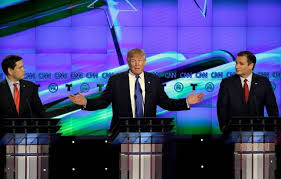
This election season in the US there has been an extraordinary and disturbing trend at work: vilifying free trade as a "job killer". The main front runners in both political parties in this Primary season are all apparently questioning free trade as a way to garner more votes.
So although in January 2015 Ted Cruz said "I am a full-throated advocate of free trade. Free trade benefits America, produces jobs,
 produces economic growth and it is good for our country", he has gone on record saying that he is not in favor of the Trans Pacific Partnership (TPP). The front-runner on the Republican side, Donald Trump says that the Trans Pacific Partnership (TPP) is a "terrible, terrible deal", and that he would cancel most of the existing trade deals as well as building a wall between the US and Mexico. And lastly, John Kasich has said that "I think that we have, in some ways, been saps. We can't have people coming in here and dumping stuff and destroying our jobs in this country. That's where I grew up! I grew up with steel workers."
On the democratic side, Hillary Clinton also opposes the Trans Pacific Partnership (TPP), But probably the most vehement anti free trader in the Primaries has been Bernie Sanders. He has gone on record saying that "Let’s be clear: the TPP is much more than a “free trade” agreement. It is part of a global race to the bottom to boost the profits of large corporations and Wall Street by outsourcing jobs; undercutting worker rights; dismantling labor, environmental, health, food safety and financial laws; and allowing corporations to challenge our laws in international tribunals rather than our own court system".
So what is going on here? Why is one of the biggest trends of the last 3 decades now being questioned and vilified by our leading politicians? Well, there is plenty of analysis in the press (see here in the FT and here in the New York Times, for example), but we need to ask 4 basic questions here:
i) why is free (or freer) trade regarded as a good thing by economists?
ii) why is there now so much opposition to free trade among politicians?
iii) what would happen if we implement some of the suggestions coming from both ends of the political spectrum?
iv) what lessons can we as economists learn from this?
So first, why is free trade regarded as a good thing by economists?. As I explain in my Principles classes, the Ricardian theory of trade says if you have a comparative (relative) advantage in doing something, you should specialize and focus on doing exactly that thing. The unfortunate part of free trade is that if you don't have a comparative advantage in a specific good or service, then the theory says you should let someone else do it and import the good or service. The obvious implication is that people will lose their jobs. And that means that as barriers to free trade have come down over the past 60 years that we will lose jobs in certain industries. But that is not the end of the story - trade theory goes on to point out that in any country the gainers from trade could compensate those with losses from free trade, and we would still be better off. It is this second part that doesn't get taught in the textbooks or emphasized enough.
But what does this mean exactly? It means that from a macro perspective, the gains coming from the industries that can take advantage of comparative and expand to dominate international markets will make more income for the country than the loss in income from declining industries which will eventually be eliminated. Of course, that is the idea behind some of the government "adjustment programs" which usually accompany free trade deals: the government provides money to help workers transition out of an industry where the country does not have a comparative advantage into an industry where the country does have a comparative advantage. This extra transition spending should be temporary, as the dynamic adjustment to a new free trade deal causes workers to move from one industry to another. That is the theory at least.
So now we can answer the second question: why is there now so much opposition to free trade among politicians? One of the UK's leading politicians of the 1980s, Norman Tebbit coined an unfortunate phrase relating to the sectorally unemployed: "on yer bike". What he meant was simply if there isn't any work where you currently live, move to where there is work. The problem with this as relates to the economic theory is that workers often do not like to move - and particularly in a country as big as the US. The loss of social networks established over years, the uprooting of children from schools that they like, often the loss of property values as major parts of certain states see everyone trying to sell at once if the town or city is not industrially diversified, and the different cultural norms in different parts of the country, are all good reasons why we observe inertia in labor mobility. And much of this loss of jobs has come because by and large the US does not have a comparative advantage in manufacturing - that sector has been in long term decline, as it has in many developed countries.
If States are not industrially diversified, there is no doubt that there will be pain - hence the so-called "rust belt" in the central US States, the fisheries in the Atlantic provinces in Canada, the dockyards of Glasgow in Scotland, and the garment industries of North Carolina are all good examples. This pain is clearly one of the festering scars of free trade policy in advanced economies around the world. So if you are a politician campaigning in these States where there has been a decline in specific industries, it is natural that you'll get votes if you oppose free trade - so politicians such as Donald Trump, Bernie Sanders and Hillary Clinton all know that if they are to have a chance of winning in these States they need to argue against free trade, and so they do.
This leads into the third question. Donald Trump has advocated rejecting the Trans-Pacific Partnership (TPP - which I regard as a coalition type free trade deal against the emergent trading might of China), and said he would raise tariffs by 45% against all goods coming in from China and other countries that he deems to be unfair. I am assuming that the Transatlantic Trade and Investment Partnership (T-TIP) with Europe will also be on the ropes too, Bernie Saunders has also said that he would only do "fair trade" deals, where this is defined as trade where wages and environmental standards are roughly equivalent to those in the US. That implies that Saunders would be against TPP, but would actually be in favor of T-TIP. But it implies that a Saunders Presidency would see international trade collapse with the developing world ( - what a lot of economists call "North-South" trade). Either of these two scenarios are not good for US economic prospects, as it implies that free trade deals which the US stands to benefit from, would possibly not come to pass, and also that we will see other countries erecting trade barriers against our goods and services.
What lessons can economists (and the general public) draw from this?
First, I think that from a theoretical standpoint we need to expand our proselytizing about free trade to make politicians and the general public understand better where the economic argument comes from, and how it needs to come as a complete package rather than just a narrow focus on the benefits. What we have failed to do as economists is recognize the costs, and how best to mitigate those costs.
Second, what can we do in the policy realm? It should mean that any free trade deal needs to come with a whole raft of moving grants and loans, retraining grants and loans, and pension and Social Security "top-ups" for those laid-off workers who are deemed to be close to retirement age). But I hear my economist friends saying - "but that might make the international rearrangement of production no longer economic, so that comparative advantage cannot fully operate. Well my argument would be "so be it". These are people's lives you are talking about, and government and business instigated policy changes should come with transitional arrangements that protect those that are most vulnerable.
Third, we need to be much more aware of the regional industrial specialization that occurs in the US when making trade deals - perhaps States could be given notice that a free trade deal will happen and then some kind of fiscal transfer can be arranged to help it generate new industries within it's borders. In this sense regional policy and trade policy are much more related than economists have recognized in the past.
And lastly, and probably the most important lesson that can be learned from this, is that economists need to be much more vocal about these public policy issues, and suggest ways in which the well-being of all our citizens can be improved, or at least maintained.