Showing posts with label Canada. Show all posts

Sunday, April 1, 2018

The bell tolls on NAFTA - so what are the "known unknowns"?

Donald Rumsfeld
Donald Rumsfeld, the U.S. defense secretary in the George W. Bush administration, once stated (back in February 2002) that "there are known knowns; there are things we know we know. We also know there are known unknowns; that is to say we know there are some things we do not know".  At present, the situation with whether NAFTA (North American Free Trade Agreement) exists this time next year is one of these "known unknowns".  In fact the date for deciding whether NAFTA will exist next year is about a month away, due to mid-term elections north of the border and the Presidential elections south of the border, which will hamper any further progress in the negotiations beyond May.  Not only that, but some decisions are to be taken also before May on the extent of the tariffs to be taken against China, in addition to the ones already announced.

Larry Kudlow - Speaking at CPAC 2015
With the new tariffs on steel and aluminium, plus the resignation of Gary Cohn as the head of the National Economic Council and President Trump's top economic adviser, there is little now to stop the advance of US economic nationalism in the US administration.  Even the new appointment of Larry Kudlow as Cohn's replacement is unlikely to change things on the trade front, as Kudlow clearly sees the bigger picture and wants to keep his new appointment and much greater political influence than he has pontificating on CNBC.  Plus in the grand scheme of things these tariffs are not that important compared to the regulatory rollback favored by Kudlow and his ilk.

In general though, the US media seems to be at a loss to understand why President Trump is pushing ahead with this agenda, and is predicting doom and gloom with the potential for trade wars to emerge, rolling back the advances made towards a fully globalized trading system.  But they do not seem to understand what is at stake here, and nor do they seem to understand the economics surrounding globalization and how financial markets are to a certain extent tied to the fate of globalization over the next month or so.  The way I tended to view the President's stance on tariffs was that it was mostly a case of "bluster" to prompt other countries to yield on their trade positions so as to obviate the need to implement tariffs. But recent events have proved that position to be wrong - President Trump is indeed willing to bypass the WTO, and implement tariffs, particularly on China (there is a good article on the growing irrelevance of the WTO from the FT here)

But the President's position on NAFTA is a little different.  President Trump was partially elected on his campaign promise to either repeal or renegotiate NAFTA, and so far the re-negotiation has been hung up on various of the US demands, most notably: i) rules of origin for autos - 85% NAFTA and 50% US for those autos sold in the US; ii) scrapping of the investor-state system, where investors from another NAFTA country can sue the government of that country if they are treated differently from how they would be treated in their own country; iii) scrapping of the trade dispute settlement mechanism whereby a panel of experts decides which country wins a particular trade dispute case; iv) an end to Canada's agricultural supply management system; v) the introduction of a sunset clause whereby all 3 countries have to renew NAFTA every 5 years.

So what is likely to happen here and what are the potential "known unknowns" here?  First, how far is President Trump likely to want to compromise to save NAFTA. Well so far the negotiations have been making slow progress, but as one might imagine, some of the US demands are proving difficult for the other NAFTA countries to accept and/or compromise around.  The investor-state system has been updated, and as the US wants it scrapped, Canada and Mexico have decided to just make it apply to them, effectively giving the US an opt out from the system.  Recent news from the talks in Mexico City appear to show that the US has now dropped all it's demands on auto content (see here), which was also a major sticking point.  While that seems like a reasonable compromise, there are still other issues like the trade dispute mechanism and the sunset clause, where it is hard to see how the different parties can come together in a deal, despite what is at stake.
The Mexican border at Yuma, AZ

As the President stated in a Reuters interview last year: "A lot of people are going to be unhappy if I terminate NAFTA. A lot of people don't realize how good it would be to terminate NAFTA because the way you're going to make the best deal is to terminate NAFTA. But people would like to see me not do that". The big problem for President Trump is not Canada, although the Canadians have taken issue with the US position here (see this recent article in their national newspaper, The Globe and Mail here), but  on the other hand Mexico is seemingly the biggest problem as far as President Trump is concerned, and largely because of the trade deficit that the U.S. runs with Mexico . Even just this morning on his way to Church, the President stopped by reporters to announce that as well as there being no DACA deal that he was still considering pulling out of NAFTA (see here) if border security did not improve. So this is clearly a huge "known unknown", and if President Trump appears not to be able to get his cherished wall on the Mexican border by a deal with the Democrats on DACA, then this appears to be the President's next best hope - allowing Mexico to remain in NAFTA, only if it pays (in part or wholly) for the new border wall.  It also perhaps is a signal that the President was not happy with the concession that his negotiators made in regard to the trade in autos.

U.S. Trade Representative Lighthizer's comments at the conclusion to the 7th round of talks in Mexico City were also revealing. He stated "As President Trump has said, we hope for a successful completion of these talks, and we would prefer a three-way, tripartite agreement. If that proves impossible, we are prepared to move on a bilateral basis, if agreement can be made."

Texas is very much involved now in trying to save NAFTA - as Canada's Financial Post pointed out in an article this week (see here), but clearly the President is not keen to compromise on NAFTA without there being some quid pro quo in the case of Mexico.

But what is at stake is probably bigger than any talk of tariffs with China, as although China is a large trading partner, the embedded nature of the trading relationships with both Mexico are far reaching. The actual size of the trading relationship with both Canada and Mexico can be seen in the figure above, which shows the flows of trade in and out of the country for 2016,  Now of course the trade relationship with Canada is unlikely to be threatened, as President Trump will likely revert to what was known previously as CUFTA (the Canada-US Free Trade Agreement), but for US States along the border with Mexico the implications are much more serious if Mexico is prohibited from continuing in NAFTA.  The figure below shows the exports by State to Mexico and it is clear that although all the border States would be hit by any new trade restrictions introduced between the US and Mexico, it is Texas that would suffer by far the most of any State.
Now it is likely that the US has a surplus on services which should likely redress some of the imbalance on the trade in goods (i.e. a trade deficit).  The latest figures we have for the U.S. Services exports were $33.3 billion; services imports of $26.3 billion, giving a U.S. services trade surplus with Mexico of $7.0 billion in 2017.  This figure also seems small to me, considering how many Mexicans come on vacation to the U.S. and also considering the dominance of the internet by U.S. multinationals, but in any case, those benefits would likely mostly flow to one U.S. State: California.

So what are the possible outcomes here?
i) First the worst scenario, with a complete withdrawal from NAFTA. No special trade relations with either Mexico or Canada.  This is now extremely unlikely, but the effects on the North American markets would definitely be highly negative if it were to occur.
ii) Second, a more likely scenario would be a withdrawal from NAFTA while at the same time an invitation to Canada to continue negotiating on a CUFTA deal.  This I think is highly likely if no concessions are made by Mexico regarding border security, and in particular, some funding for the wall. Clearly Mexican markets would take a big hit if this were to occur, and the Texan economy in particular could potentially be badly hit. In the U.S., the auto sector and the energy sector would be particularly vulnerable.
iii) Third, another possible scenario which has just appeared due to the President's retreat from doing a DACA deal with Democrats, that of the NAFTA being successfully concluded due to a side deal that the President does with the Mexicans such that they partially agree to some unspecified payments so that the President gets a partial victory.  Although unlikely, due to Mexican opposition to any acquiescence on the wall, it is possible and would likely have no effect on the U.S. markets but would see a relief rally in Canadian and Mexican stockmarkets.
iv) Fourth, a successful conclusion to NAFTA without any side agreement, but with some of President Trump's signature demands embedded into the agreement, notably reformed dispute settlement mechanism and a sunset clause on the agreement, subject to a review and further revisions at some point in the future.  A relief rally in all 3 participant countries would likely occur on such news.

If I were forced to choose, I would say that outcome ii) and iv) are most likely, but in fact I think for electoral reasons I think President Trump's instincts will be to withdraw from NAFTA, unless certain key concessions are won.  . 

Wednesday, January 10, 2018

Happy New Year for 2018!! Economic outlook and investment strategy

Happy New Year to all my Econoblog readers, and readers through the syndication to Seeking Alpha. As usual, I will try and distill my "top down" macro views for prospects for 2018 in terms of economic growth, the stockmarket, and interest rates.

Backdrop

As we enter the 10th year since the last downturn, the global economy is living on borrowed time - and I mean that literally!  As I explored in my last Econoblog posting (see here), the business cycle is elongating, for either temporary or permanent reasons.  My own predilection is for a permanent elongation (mostly due to the findings from my own academic research agenda), but either way, an elongation is now occurring for this phase of the business cycle as we move into 2018.

So the real question is what will perform best as we move into the late stages of the business cycle expansion, and how to hedge the uncertainty of the coming downturn whenever it is. Well there are several different approaches one can take to answering this question, so I will first do a review of what I see are the prospects for the different regions of the world, and then focus in on what I think makes sense for my own investment strategy.

A quick aside. 2017 has been an exceptional year in the stockmarkets, and the performance of the major stockmarkets in the world has been positive almost everywhere. In the US, the S&P 500 was up 19.4%, the DJIA up 25.1% and the Nasdaq up an astounding 28.2%, while the 10 year US government bond yield is still under 3%.  But although the US performed well, many other countries outperformed the US.  The chart below shows the return of different stockmarkets (in US$ terms), and if we use the S&P 500 as probably the best overall barometer for the entire US stockmarkets, then the US is near the bottom of the list in terms of performance for 2017.
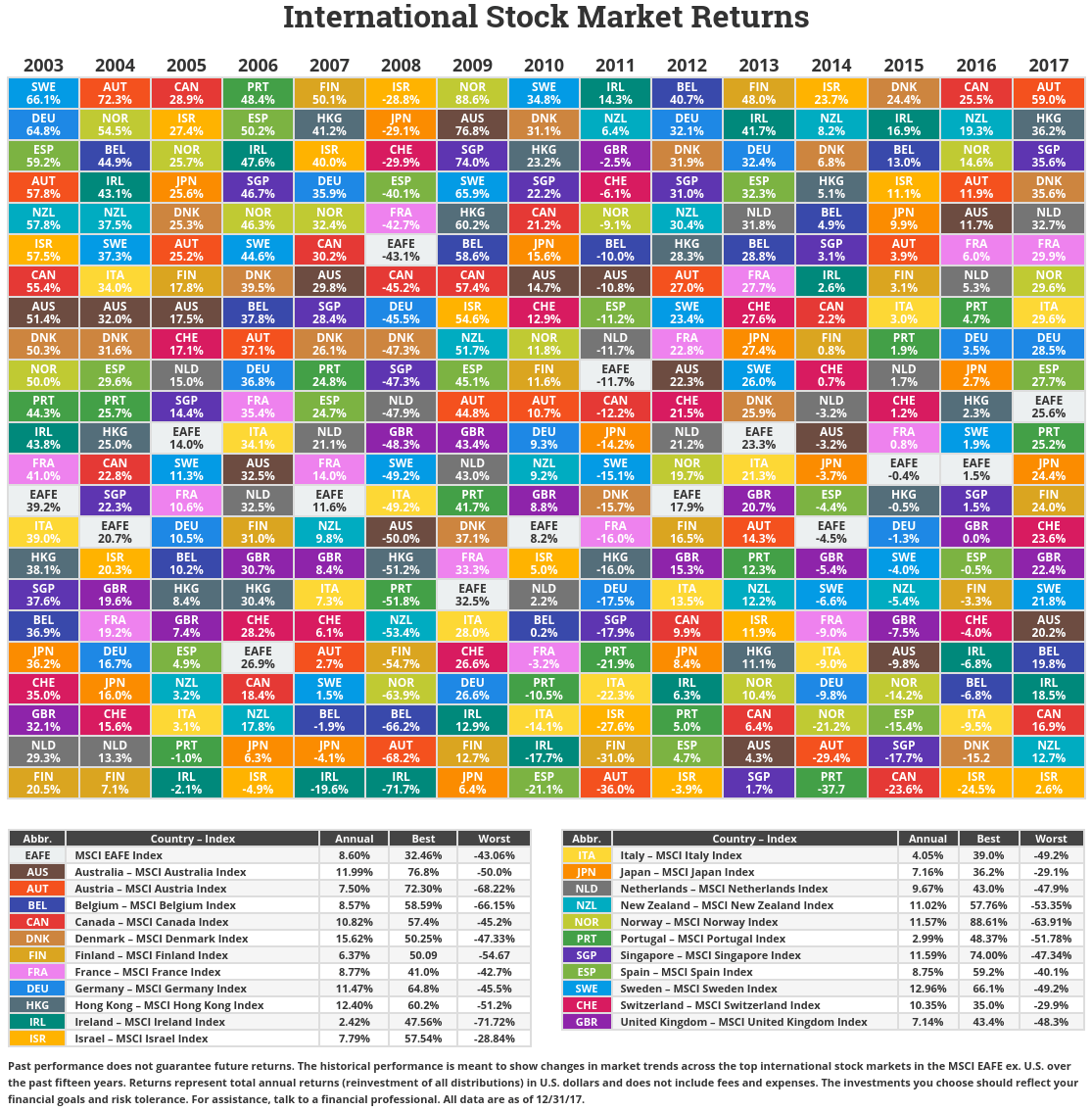
Novel Investor International Markets Returns Table
Source: Novel Investor

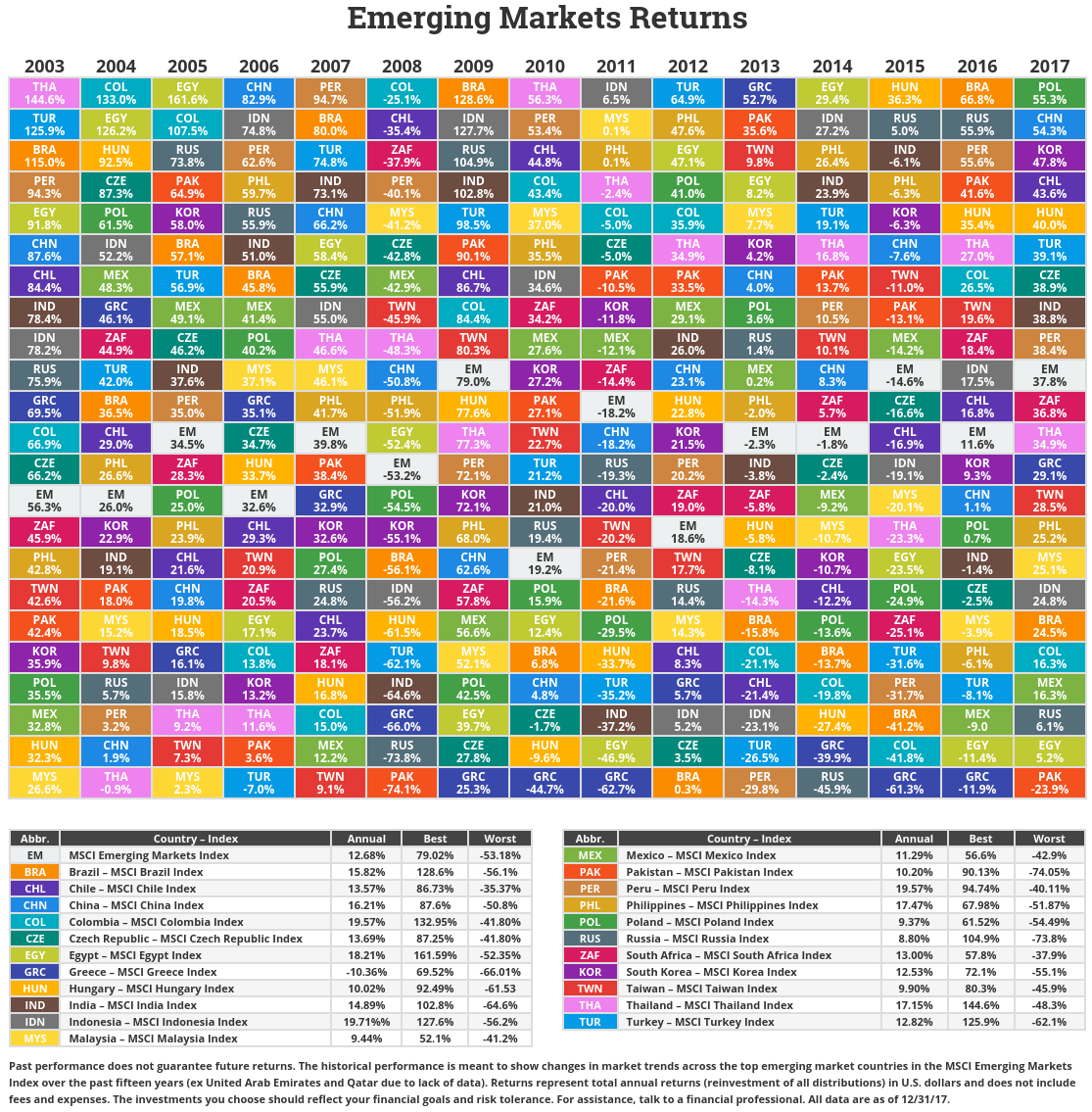
But this also doesn't consider other classes of assets, and the website Novel Investor once again has this covered with a chart that shows that emerging market stockmarkets outperformed all other classes of stocks.  This is due to the fact that emerging market stockmarkets have had a fairly tepid performance throughout this business cycle upswing, so in the late stages of the upswing in growth, obviously this will boost commodity prices for many things, which will allow emerging market stockmarkets to outperform.

Novel Investor Asset Class Returns TableSource: Novel Investor

But what of individual emerging markets?  Where performed the best?  Well once again, Novel investor has us covered here too.

Novel Investor Asset Class Returns Table

Source: NovelInvestor.com

So Poland, China, South Korea and Hungary were the big winners for 2017.  And Pakistan, which several commentators said would perform very well in 2017, was the big loser.  And that really highlights a problem with emerging market economies and individual emerging markets - they are very volatile and it is really a fools game trying to pick which market will be the winner in any particular year.  But there again, that's why anyone interested in investing in emerging markets would be wise to buy an emerging market mutual fund rather than stocks in any individual country.

Back to my thoughts about 2018.  So with the backdrop of the current phase of the business cycle and the fact that US interest rates are likely to rise in 2018, let's look at each region in turn and then devise an economic outlook and investment position for 2018.

North America


The US has had a great run in 2017, but with rising rates, and an erratic President, with the good news for US corporations now delivered in terms of the tax reform, further progress with President Trump's agenda will be difficult.  The President will need cooperation from democrats if he is to pursue his plans to pass an infrastructure spending package, and the impasse on immigration doesn't seem to bode well for cooperation in that or in any other area for that matter.  So I can only conclude that most of the good news for stocks has already now been achieved, and there will be little more coming down the pipeline.  If there is more and I am wrong, then clearly the infrastructure and construction companies will do well.  Given the political uncertainty in the US surrounding the mid-term elections and the ongoing investigations together with rising interest rates and withdrawal of QE, I think the US will underperform compared to other parts of the developed world and certainly with respect to the emerging markets.

I think NAFTA will likely collapse in 2018, which will mean that Mexico is probably not a stable place to invest, but Canada will likely outperform both the US and Mexico, given that the US has made it clear that if NAFTA is terminated, then the US would still be open to falling back to the original CUFTA trade deal that was the precursor to NAFTA.  So in general, I think that Canadian stocks are a safer bet than US stocks for 2018 and should be bought on any signs of weakness.

The other factor that has had very little press so far this year is that yes, we have a new Chair of the Fed, Jay Powell.  As with all Fed Chairs, Jay is likely to have an early stumble or mishap in the job as he finds his feet.  That may unnerve the markets as well.  I would expect that maybe the FOMC might act too aggressively to increase rates than is necessary, or may "fall behind the curve" at some point.  Either way, there are clearly consequences for the stockmarkets here.

The US dollar is also a bit of a conundrum for 2018.  Rising interest rates usually portend a stronger currency, and that's what we have seen so far but with the protectionism proposed by the Trump administration and the possibility that the Chinese may no longer buy so many bonds, that in turn will have an uncertain effect on the currency.  As can be seen from the plot of the trade weighted US dollar, despite the recent depreciation, we are close to all time highs already.  Obviously from international economics that means that the markets have already discounted further rate rises, and are perhaps now looking for reasons not to push the US currency any higher.


Europe

European stockmarkets generally had a great year in 2017, and as QE continues in 2018, it is likely that this will continue at least until the second half of the year.  If you look at the performance of the European stockmarkets in recent years, they nearly all had downturns in 2014 and/or 2015, so they are basically still catching up with the US, and of course the banking sectors in the EU are still fragile but improving as time goes on.  The Mifid2 directive, which was supposed to come into force at the beginning of this year will likely (when implemented in March) increase transparency and efficiency in EU stockmarkets which will tend to increase confidence and spur greater stockmarket returns.

The two areas where there are significant risks are Brexit and Greece.  With Brexit, there is no certainty yet that a trade deal between the UK and the EU will be achieved before the exit date of March 2019.  Although Prime Minister Theresa May has successfully concluded the conditions of the breakup by agreeing to a hefty payment to the EU and safeguarding the right of EU nationals to remain in the UK after March 2019, this does not ensure that a trade deal will be struck in time.  The current policy of "gradual divergence" (see here) does not bode well for a consensus on any new trade deal as the EU does not see this as consistent with having a trade deal that would create a level playing field between the UK and the EU - it is seen as cherry-picking the areas where the UK would not want to diverge for fear of losing business, while having the right to diverge in other areas.  Also the Chancellor, Philip Hammond, who is much more in favor of a "soft" Brexit, has broached the idea of a new customs union with the EU (see here), but this would not allow the UK much independence when negotiating trade deals with other countries as the UK's hands would already be tied in relation to trade policy because of the EU customs union.   The second area of risk remains Greece.  Greece is now experiencing growth again, but the political situation is still not completely stable, as an elections must be called by October 2019, and the current government is unlikely to want to wait that long, so a general election is likely to be called in the second quarter of 2018.  The outcome of the election is likely to determine whether Greece continues to follow the path of fiscal consolidation insisted upon the rest of the EU, or a new government pushes the country in a different direction.

From an investment standpoint probably the Nordic countries are most insulated from these risks, although probably Central and Eastern Europe stockmarkets are still likely to be the most volatile and may yet again outperform the Western and Southern European member states.

Japan

The news from Japan has basically been good in 2017.  The efforts to stimulate the economy using QE appear to be now paying off, with economic growth now positive for the 7th consecutive quarter (see here), but mostly due to external factors rather than domestic growth ( - consumption was still in decline in the last quarter reported).  Nevertheless recent revisions to 3rd quarter GDP suggest that the economy was growing faster than previously thought, which allowed the stockmarket to remain buoyant, but it does mean that without the external demand stimulus and the continuing QE, the economy would likely have experienced only tepid growth.

The Japanese economy therefore does appear to have achieved "escape velocity" which means that deflation is now in the rear view mirror, despite the fact that inflation is still falling short of the Bank of Japan's inflation targets.  This should allow the Japanese stockmarket to make further gains in 2018.  In fact, if correct, a recent FT article (see here) suggests that the labor market is now in a state of severe shortage, which should allow wages to start to rise in a more sustained.  That, in turn, will boost the stockmarket.

Rest of Asia

My views on China are relatively well known after my recent presentation on OBOR (One Belt One Road).  But to recap, I think that China will grow in 2018, but substantially less rapidly than it did in 2017 as OBOR projects take production out of the country ( - remember that GDP only includes production within the borders of a country).  OBOR is clearly long term geopolitical and economic investment project, so it is expected that GDP would slow...GNP, on the other hand, will stay relatively robust.  Anyone who has been to China can attest to the fact that although investment is still high, it is clearly slowing as there is now a substantial amount of "infrastructure slack" in the economy ( - visible in terms of "ghost" trade and logistics inland ports, empty buildings and relatively empty new highways and fast speed trains out in the rural west).  And although consumption is now clearly on display in the major cities, I think that China's next push must be to modernize it's agricultural sector based in the rural areas, and that will not be easy.

As for India, 2017 was quite rocky (what with the monetary reforms and the unpopular new VAT tax), but as long as tinkering with major part of the macroeconomy do not continue under the Modi government, the prospects for an uptick in growth appear quite good.

Africa

The election of Cyril Ramaphosa as ANC Chair and therefore leader of the party, caused a relief rally
in late 2017, and I believe this will continue through 2018, with much more business friendly approaches making an appearance in South Africa and hopefully a more pragmatic approach to achieving the lifting of all boats through more sensible economic policies for the whole economy will start to bear fruit.

Investment Strategy

So given my macroeconomic views detailed above, what does this imply about investment strategy?  I have produced the cyclically adjusted price to earnings ratios (CAPE ratio) for all the countries discussed above in the figure below.  The data ends in November of 2017, so although we are missing one datapoint it is clear that the US has, since early 2016, had the highest CAPE.  That means that the US firms' stockmarket prices were highest compared to their earnings at this stage of the business cycle.  Then comes Japan, which is not far behind.  At the bottom of the CAPE rankings are UK and China, while the countries sandwiched in the middle are India and collectively the European countries. 


Source: http://shiller.barclays.com/SM/12/en/indices/static/historic-ratios.app
But what does that mean then?  I think what it means is that stocks in both China and the UK are valued at roughly half the amount that US and Japanese stocks are.  That in turn tends to suggest that i) if stockmarkets globally continue to climb, it is likely that those with lower CAPEs will grow faster than those with higher CAPEs; and ii) that if there were to be a pullback, the amount of the pullback is likely to be less in both the UK and China simply because those two markets have not climbed to nearly the same levels as have both the US and Japan.

So for an investment strategy based around the viewpoint expressed here, I would suggest:
i) underweight on US and Japanese stocks
ii) overweight on UK and Chinese stocks
iii) some weight in India and European stocks
iv) underweight on US government bond holdings
v) overweight on foreign bonds, particularly of those countries where China might want to substitute  holdings.
vi) overweight on other EM stocks, as these countries try to catch up with the phenomenal pick up in the US stockmarket.

And yes, I have already rearranged my own portfolio to put my proverbial money where my mouth is!


Monday, August 21, 2017

Are "Trump Trade Wars" Inevitable?

President Donald Trump, at his joint address to Congress on February 28th 2017 stated: “I believe strongly in free trade, but it also has to be fair trade. It’s been a long time since we had fair trade. The first Republican president, Abraham Lincoln, warned that the abandonment of the protective policy of the American government would create want and ruin in the country… It’s time we heeded his advice and his ways.”
Free trade has been at the cornerstone of capitalist democratic economies now for many years, so this statement from the President of the biggest trading country in the world looks to President Lincoln to justify a return to protectionism and a reversal of the trend to ever freer trade that has been characterized by the post World War II international economic consensus. This has economists somewhat aghast at what is going on with the Trump administration, as after the new President immediately withdrew from the progressive Trans-Pacific Partnership (TPP) agreement, we also know that the Trump administration is now looking to not only renegotiate NAFTA but also has explored the idea of perhaps bypassing World Trade Organization (WTO) rules so as to impose a border adjustment tax (we'll come to what that is below).

So how will this all play out? Well there is already a battle inside the administration about how protectionist the policy pronouncements will be (see here), and it looks like the battle between the two factions will continue for a while yet, despite the fact that Steve Bannon has left the White House staff. In a recent NYT article (see here) there is doubt that President Trump will be able (or want) to follow through on his campaign promises with as much gusto as he suggested he would on the campaign trail. And in an article in the FT (see here) there were signs emerging that the Beijing relationship has now becoming badly frayed as the Trump administration initiates several unfair trade practices investigations. The danger though here is that the "soft-liners", although they might win in the short run, will not hold the upper hand as we approach the mid-term elections in late 2018 and beyond, as the administration realizes they are being punished at the ballot box for not fulfilling on these commitments.
So let's take stock of where we are in terms of President Trump's campaign promises. In not particular order, they were:

1. Withdraw from TPP

2. Halt T-TIP negotiations

3. Renegotiate or scrap NAFTA

4. Institute a border tax (tariffs) with Mexico so as to pay for a wall on the Mexican border

5. Declare China to be a currency manipulator

6. Impose a border adjustment tax (BAT) as part of the tax reform package that should be forthcoming from the administration.

The first 2 on the list have now been completed, but the third is the one that has everyone guessing as to the consequences, so let's look at NAFTA first. 

NAFTA is now embedded into the North American economy, so changing the basis of the Treaty that established NAFTA requires a summit with both Canada and Mexico, and the negotiations for this summit are now taking place. 

President Trump has made it clear that he wants a complete rewrite of NAFTA, and that led to a tense start to the negotiations, which got underway this week (see here). The Canadian foreign minister, Chrystia Freeland, noted that “We pursue trade, free and fair, knowing it is not a zero-sum game”. She added that: “it is worth pointing out that we are the biggest client of the United States. Canada buys more from the U.S. than China, the UK and Japan combined.” 

Perhaps the US team in the negotiations, led by U.S. trade representative Richard Lighthizer, sees trade bilateral deficits ( - and the US does run a small deficit with Canada) as a measure of fairness of trade with that entity.  Any student of international economics understands that this is not the case - it is simply a component of the overall trade balance, and reflects a balance of comparative advantages between the two countries. Also it should be noted that Trump's ire has not been directed at Canada (with the isolated case of the softwood lumber issue) but in the NAFTA context his ire has largely been directed at Mexico. This is because whereas the U.S. ran a goods and services trade surplus with Canada in 2016 of about $12.5bn, the U.S. ran a goods and services trade deficit with Mexico of $55.6bn.  But as we shall see below, the trade deficit with Mexico is dwarfed by the trade deficit with China.

Now although the topics to be discussed are rules of origin, managed trade (read more quotas), and so-called "Chapter 19" dispute resolution, whatever is in NAFTA 2.0 better reduce the U.S.'s trade deficit with Mexico, otherwise this will likely prompt President Trump to threaten withdrawal from NAFTA. But given the fact that much of the trade between the U.S. and Mexico is intermediate goods trade, it does make sense that the biggest part of the cross border trade would be the finished product (for example a vehicle), rather than the sum of all the parts that might be produced in the U.S. that are exported to Mexico (where the vehicle is then assembled). Given then that it is unlikely that trade with Mexico could ever get to close to in balance (or in surplus), I think that President Trump, given that he has made such a big issue of either pulling out of NAFTA or completely rewriting it, may decide to pull out if the Mexicans don't walk out first.  

What I think will possibly transpire is a return to CUFTA, which was the free trade agreement with Canada that formed the original basis for NAFTA. Although other economists might not agree with my assessment, I believe that President Trump will feel that he has to deliver on this particular promise if he is to stand any chance of re-election.  In order for NAFTA 2.0 to eliminate the trade deficit with Mexico would be import quotas.  I think these will be rejected by Canada, as they would also affect Canadian exports to the US. So there is no way forward that would satisfy all 3 parties and therefore this will possibly lead to withdrawal. Since the announcement of Steve Bannon's ouster as a Trump advisor, the probability of withdrawal has gone down, but the trade representative will still have difficulty delivering what the President wants out of a re-write of NAFTA.

When campaigning, Donald Trump also mentioned a 35 percent tariff on autos made by U.S. companies in Mexico. This tariff was originally mentioned with regard to also funding construction of the wall. This tariff would currently go against the rules of NAFTA so is unlikely to be implemented while the U.S. remains inside NAFTA. So if the U.S. does leave NAFTA then this idea might get resurrected as a means to deter manufacturing or assembly going south of the border.

On the campaign trail President Trump also promised to name China as a "currency manipulator".  But having met with Premier Xi Jingpin, Trump declared that China had manipulated its currency in the past, but was moving to correct the level of the yuan, and hence it would not be necessary to name China as a "currency manipulator".  So this is now off the table.  President Trump did, however, decide to pursue several probes against China, most notably on intellectual property (see here), but also on steel. Although the U.S. has not imposed steel tariffs yet, it seems that they are likely to do so (see here).  This so-called "section 232" review ( - that was initiated because of fears that threats to the U.S. steel industry from imports would not be in the interests of national security) has to be made public by mid-January. Then President Trump will have 90 days to react, perhaps implementing a steep tariff on steel imports principally from China, but also from all other steel producers.

The Border Adjustment Tax (BAT) has now also been abandoned as a proposition, but just to keep my readers fully informed, I will explain exactly what a BAT is. A BAT is essentially an import tariff coupled with an export subsidy by means of making exports tax free.  

So that is the current state of play on international trade policy and the Trump administration. As mentioned above, the current administration appears to be particularly concerned about turning the overall U.S. trade deficit into a surplus, or at least reducing it.  In the table below from the BEA, the bilateral trade deficit or surplus for the U.S.'s main trading partners is shown, and it can be seen that the majority of the deficit is with China, and this is fairly consistent over time. 


Source: US Census Bureau, Dept of Commerce


Of course what really matters here is the trend in the data, so I thought I would download the data and see exactly how a long term perspective can show that actually China is pretty much the only problem. 


Data source: Dept of Commerce; Graphic by blog author
Now the graphic clearly shows that although there was a deterioration in the trade balance with countries like Japan, Germany and Mexico over the early 2000s, it is the trade deficit with China that really takes off in the early part of the century, and although for countries like Canada the trade balance has actually improved, for China, with only a brief respite during the great recession, the overall trend has been towards a widening of the deficit.


Chinese President Xi Jinping and U.S. President Donald Trump shake hands
So from an economic assessment, if one agrees with this approach, the President should really focus mostly on China, as this is where much of the trade deficit originates from. But what is the best way to tackle this? The U.S. trade representative has a detailed list of objectives which can be found here, but of course these only state objectives and not solutions.  

On a recent trip to China I visited a large container port off the coast of Shanghai ( - in fact it is at present the largest container port in the world), and was surprised to hear that half of the containers travel to China empty, but every single container is full leaving China. So the main problem with trading with China (and this goes for the EU too), is that China's trade with most of the rest of the world is unbalanced.  

This highlights the fact that although half of this problem is the U.S.'s problem, the flip side is that China clearly has a lack of consumption of imports in the sense that savings are high and when the Chinese do consume, much of their urban dwellers consume Chinese goods. The China issue prompted President Trump and President Jinping to set up a "US - China Comprehensive Dialogue", but as reported in the Financial Times last month (see here), this dialogue is a talking shop regarding the issues to be tackled, but nothing concrete to make it happen, and definitely no sign of agreement on the way forward. 

Clearly the Trump administration has changed tack and instead of calling the Chinese currency manipulators, has decided to go after the Chinese on various fronts by launching probes in specific problematic areas. The results of these probes though, if acted upon, will likely prompt reprisals, and perhaps WTO arbitration cases against the U.S. Certainly the Chinese appreciate that although the U.S. is not their largest trading partner ( - the EU is), that there are considerable risks to domestic economic growth if there is a trade war with the U.S.

So is a trade war inevitable with China?  I think that the answer here is still up in the air, but I still think the most likely outcome is narrowly in favor of a trade war. This is the case particularly if we see a degradation in the NAFTA talks appearing over the next few weeks.  A sign pointing in a different direction has also appeared though, and that relates to the earlier probe on steel which the President launched. There has still been no announcement as to the results of this probe, and this is likely because the announcement has been held back as it would be damaging to trade with China. How to handle this will definitely require some diplomacy, as President Trump will not want to make outright enemies of the Chinese.   


Monday, January 6, 2014

2014 and the Business Cycle: Continuing Recovery and Another Year of Opportunity in the Stockmarkets?


First off, Happy New Year to all my Econoblog readers.  If you want a review of 2013, rather than rabbittng on here, I thought I would just point you to a wonderful article in The Atlantic on the Most Important Economic Trends in 2013 which you can find here. In this Econoblog I want to look ahead to what might happen in 2014, as some eminent economists have been doing at the most recent American Economics Association meeting..

As the business cycle is now in heading into the later part of the cycle, with the danger of recession and deflation receding, most countries will experience accelerating growth this year.  Although markets are jittery about the Fed’s signal to taper monetary policy, this is long overdue in my view, and will only have a marginal effect on economic growth in the US and other developing countries.  The economic process of re-invigorating the economy through stimulus has now done its magic, and in North America, Europe and now Japan, the growth dynamic has started to take on a life of its own, so that the agents of stimulus can now withdraw their assistance as a catalyst for economic growth.

So there are 2 further issues here – first, how will economic growth be distributed among the developed countries, and second, given what is going on in the developed world, what are the prospects for the developing countries.

Although the consensus is almost uniformally positive for the US for 2014, it is still probably the most uncertain country in the developing world to forecast for 2014, as there are so many factors that might impinge upon economic growth rates. The most notable are fiscal matters and the political problems in Congress, the ongoing taper, and when the actual tightening of monetary policy will begin, how movements in long term interest rates will impact the housing market and also lastly, how the dollar will behave during the upcoming year.  If the current truce in Congress yields more bi-partisan consensus on how to move ahead in other contentious areas (such as immigration reform, for example), then this could boost growth as confidence is at least partially restored in the US political process.  Given a brighter fiscal outlook, this would mean that Fed purchases of government bonds could be slowed much more quickly than Mortgage backed securities (MBS), which would allow a residual boost to the housing market rather than propping up a shaky Federal government credit rating. Longer term interest rates are key in determining the course of mortgage rates, and if the Fed keeps these low enough for long enough, the housing market could really boom, setting off a real investment boom in the rest of the economy.  Of course everything could go the other way as well, leading to a further downgrade in the credit rating of US debt, a Fed that ends up having to reverse the taper because of a sagging labor market, and a housing market that experiences a bubble because of prices rising too far too fast. 
In my view, the history of economic cycles points to a positive future though for the US, and although some of the shorter term cyclical effects will be present, the dominant longer term cyclical features will push the US forward without any major internal economic dislocations, leading to another good year for both the housing and stock markets.  This of course implies another bad year for the bond market with yields moving upwards to levels more typically associated with this stage of the business cycle.

But perhaps the best opportunities in North America lie not in the US, but in Canada.  The Canadian market has been extremely stable through the recent turmoil and the Canadian stockmarket has really not shown much of a return compared with its US counterpart, which in my opinion is almost counter-intuitive, but is probably based on the perception that Canada has an economy based much more on commodities than the US does.  Nevertheless, in my view the Canadian market still has much less downside risk that the US market does, and much more upside.

Japan and the EU have less potential for growth as demographic factors restrain both entities. The fact that Abenomics seems to continue to deliver the goods will push Japanese markets higher and lead to the deflationary threat receding.  In the EU the resurgence of the northern member states will continue and the Southern member states will start to emerge from the difficult deflationary period they have been in. 

The biggest risks, but also the biggest rewards in 2014, lie in the developing world.  Developing country markets were rocked by the initial announcement of a taper, but now that the ongoing taper and then tightening has been priced into the markets the real effects on the developing markets should be apparent. As monetary tightening occurs in the US, so the liquidity glut will start to disappear, putting some pressure on developing countries.  Now the big question is, how big will the impact be on countries like the BRICSA countries.  Brazil should be cushioned by the massive infrastructure spending going on there for the Olympics and the World Cup, while Russia really is not dependent on the stimulus as it is natural resource prices that really drive the Russian market.  South Africa is certainly not a large holder of US bonds so the taper will likely have minimal effects on that country.  No, the biggest risk is in both China and India, where both countries have a significant interest in holdings of US debt. 


Given the negative announcement effect of the Fed’s taper, I believe that possibly the best performing markets will be in Canada, parts of Latin America, Africa and parts of Europe next year. Now I have put my neck on the line, let's see what happens!

Featured Post

Free Trade on Trial - What are the Lessons for Economists?

This election season in the US there has been an extraordinary and disturbing trend at work: vilifying free trade as a "job kille...

Popular Posts

Search This Blog