Showing posts with label education. Show all posts

Sunday, September 4, 2011

Even without a double dip, should we feel bad about the US economy?

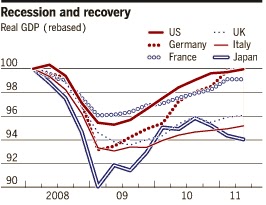
The grim outlook outlined by Martin Wolf in his FT column this week was a stark reminder that economic measurements, while being constructs that usually measure what we want them to, can sometimes not reveal what we want them to reveal.  The example of our definition of a recession is a good example and the one used by Wolf in his column.  By the measures used by the business cycle dating committee of the National Bureau for Economic Research (NBER), the recession ended in June 2009, and yet here we are 24 months later still at real output levels that are below those of the peak of the previous cycle.  The graphic from Martin Wolf's article is reproduced on the left, and shows that US real GDP is still slightly below it's peak in late 2007 and that other countries such as Japan, Italy, the UK and France are also still languishing at output levels way below their peak in the second quarter of 2007.

The fact that the vast majority of the American general public believe that the US economy is still in recession.  According to a CNN poll (see here) only 18% of Americans believe that we are not in recession right now, so this also does not accord with the way that economists measure recessions, and suggests that we might need to review this, or at least re-categorise the phases of the business cycle!


So what should be our measure of a "recession"?  I have heard many commentators say that although we are still not officially in a recession, it sure still feels like one, particularly when unemployment is still high and there are still calls for economic stimulus like the one heard only today from Fed Chicago District President Charles Evans (see here).  But given what has happened in Japan and what appears to be happening in some other developed countries, maybe we should reconsider our definition of recession as a cyclical downturn and recovery up to the point where we surpass the level of real GDP achieved at the peak of the previous boom. In fact with a growing population even this is unsatisfactory because 4 years ago in 2007 the population was smaller than it is today in nearly all of these countries ( - the exception perhaps being Japan) so if we measure output on the basis of output per head of population (or per capita), we would take longer than indicated in the graph above to get to the same level of output per capita so we would be calling the recession over before it really ended. In fact, to be frank I am in favor of changing our definition of a recession because the current measure only focuses on the downturn and does not focus on what happens afterwards - plainly Japan's experience in the 1990s plus our own recent experience suggest that not all downturns are followed by rapid upturns.


All this is even more relevant given the release of the employment statistics on Friday - and the New York Times had a great graph in it's economics top story on the release - an update of the graph originally used by Nancy Polosi to justify the stimulus in the heady first 100 days of the Obama administration back in 2009.  The frightening thing about the graph on the left is that it most clearly shows why this current downturn has been much different from previous downturns. The previous downturn to be matched against the Great Depression was the downturn in the early 1980s where employment fell by 3% from the peak of employment. This last recession caused job losses for way longer than the other recessions ( - in the early 1980s the job losses started turning around after 15 months whereas it took 26 months in this downturn), and way bigger than other recent recessions (over a 6% fall in employment).  The big picture shows that we have only managed to claw back 1% of the loss in jobs, despite economic stimulus and the Fed pumping credit and money into the economy.

I think a much more serious problem is another quite different story that the New York Times (august newspaper though it is) does not bring out in its reporting. If you look at the recessions of the 1970s, 80s and 90s and then the 2 recessions of the 00s, it seems clear to me that the US labor market is much less able to cope with recessions than it used to be - the recovery times seem to be longer and much more drawn out than they were even 20 years ago. To me this implies that there is some very serious changes going on - some of it structural, but I think something must be also be going on in terms of reluctance to hire - for example do companies delay hiring much longer than they used to, asking their current employees to do more overtime for a longer period of time before they decide to bite the bullet?  I'm not sure we know the answers to these questions yet, but clearly things are changing for US workers, and changing fast!  A pretty grim interpretation for the reasons for this are also given today by Robert Reich in the New York Times and although I don't go along with everything he says, I do agree that we need to focus on education, but I would also add that the US really also needs to focus on marketing itself to the rest of the world - countries that sell products to the developing countries (where the economic growth is right now) is one of the best ways to help expand our economy.

So to answer the question I pose for this blog, the response is clearly a resounding "No"! But for all the problems with the labor market ( - and given that it's really no surprise that Obama recently chose a Labor economist, Alan B. Krueger, to head up his economic team), the US has a lot going for it. It has some of the most dynamic companies in the world, and it is far ahead of most countries in the area of technology - but these advantages will narrow compared to Europe and Asia if the US does not focus on what leads to these advantages - education! I think what the US is essentially finding out is that although the military gave you economic power back during the cold war, spending a lot on military does not give you that advantage now. Countries that have focused more on education over the last 20 years (e.g. Finland, Germany, South Korea etc) are now doing very well thank you - countries that have not grown as fast.

What should be done then? I think a good start would be to redefine what a recession is, re-prioritize government spending towards education and away from the military, and to set up some kind of corporate international opportunities bureau which would list foreign opportunities and so US companies would be more aware and able to more easily grasp new overseas opportunities.  

Monday, February 7, 2011

Texas Trouble

Paul Krugman recently wrote about a “Texas Tragedy” in relation to the budget cuts that are going to have to be made in the upcoming legislative session in Austin. Certainly this last election in Texas was a farce as the true extent of the budget problems were kept from the voters (in my cynical mind) to ensure a Republican victory and of course the re-election of Governor Rick Perry. And now the alarm bells are certainly ringing loud and clear in all state-funded institutions (including my own), with virtually all planning on hold now until the extent of the cuts is made a little clearer.

But for those like Krugman who live outside of the State, I should start off by saying that there is really one group that is going to be drastically effected in Texas – the poor. For those who “have” and who are educated, the Texas budget crisis is not as bad as might be expected. Certainly at the University level, with several Universities now running early retirement programs, with some programs being abandoned and plans to combine existing programs between Universities in the same geographical proximity, this should yield some savings and so ease the pain. In general educated workers tend to be more mobile as well, so they are likely to head for other states if they are laid off in the private sector. Plus the housing market downtown hasn’t nearly been as bad in Texas as say Florida or Arizona, so there is still considerable mobility.

No, the tragedy of the cuts lies with the poorer segments of the population and the economically dislocated. But more about that in a moment. I first want to explain the way in which budgets are formulated in Texas, which is unusual, to say the least.

In Texas the legislature meets every 2 years for a short period of time in the spring and hammers out the budget as well as any new legislation. This saves money on one front, as paying annual salaries for legislators is not required as it is in most states or Canadian provinces with standing legislatives. But it leads to all sorts of problems on other fronts. First, a budget is not enacted and revised every year ( - the legislature in Texas is in essence currently making 2 budgets – one for 2011 and one for 2012). So when there is an economic downturn, the budget isn’t adjusted gradually, but on a two year basis – hence much larger cuts are likely this year in the state budget given the deficit last year, and this won’t be revised for another 2 years even though the economy could rebound In the second half of 2011, giving the State a surplus in 2012. Second, it also leads to suboptimal lawmaking as well, as laws are made during the legislative session, and then cannot be revised until 2 years later. While I support the idea of a part-time legislature as a cost-saving measure, I do think the legislature should meet at least once a year, perhaps for a short session just to revise budgets and amend existing laws, if needed.

The other thing that I think is a little crazy in Texas is that the State only has a sales tax for general tax collection purposes. Particularly during recessions like the most recent downturn, US consumers retrenched, leading to an increase in the US savings rate, which I (like most other economists) think was a good thing, as the US savings rate has been chronically low for some years and was a source of international economic imbalances. But of course, a higher savings rate really clobbers state revenues, and causes a disproportionate decline in revenues. To make things worse, the state even has a “tax free” weekend in September at the beginning of school year which caused an absolute shopping blitz in 2010 as cash-strapped parents, among others, avoided paying taxes on all clothes and school items.

Texas, like most states, has Balanced Budget legislation, and while this is all well and good, it really has a terrible impact if the recession occurs immediately after the legislature meets, as any overrun during the subsequent nearly 2 years has to be corrected with a surplus as soon as the legislature meets again two years later. That is the situation that we now find ourselves in. Here, in my opinion, Texas should really learn from Europe. The one part of the Stability and Growth pact that is, in my opinion, very sensible, is the part relating to budgetary measures during periods of recessions. The pact states that member states are exempt from abiding by the 3% of GDP limit on budget deficits in severe recessions. Of course that means that Texas would have to be able to issue bonds to cover the deficit, and that could lead to a build up of state debt that was unsustainable. I would argue that there are other options – one would be to have a temporary increase in tax (what might be called a “solidarity tax”) – another would be to build up an even bigger fund than the current “rainy day fund” ( - perhaps calling it a “recession fund”) which could be spent to offset a decline in state revenues during bad times.  Another approach would be to calculate a cyclically adjusted budget  metric that would automatically yield a surplus in the expansionary phase of the business cycle and a deficit in
the contractionary phase.
Of course the type of taxation we have in Texas is also, in my view, a problem. What Texas really needs is an income tax, and democrats have long recognized that this is also the fairest way of taxing the population given the extremely wide distribution of income in the state. But of course Democrats these days never get a majority so have never been able to enact such a change, and many Republicans don’t like the idea as it would mean greater taxes for their constituency – the rich. But apart from the politics, this tax system is a problem, as it means that the extreme poor still get taxed when they spend, even if they hardly have any income. With an income tax you could exempt all the extreme poor from paying the tax and at the same time get rid of the sales tax completely like New Hampshire has done.  I think most Texans are afraid that introducing an income tax would leave 2 taxes in place ( - that is, they don't trust their State government to repeal the sales tax), so doing this would have to be entirely contingent on removing the sales tax. 

So these are my proposals for Texas. First, set up a revenue commission at the state level to explore the implications of changing the tax system in Texas and then present this to the State politicians to start a debate on moving to a fairer tax structure. Second, get rid of the “tax free” weekend as it is a ridiculous gesture ( - why should I not pay tax just because of when I’m available to shop?). Third readjust the budget every year with a short session of the legislature. Lastly, establish a “recession fund” into which the state has to put a certain percentage of revenues during good times so as to offset any drop in revenues.

Featured Post

Free Trade on Trial - What are the Lessons for Economists?

This election season in the US there has been an extraordinary and disturbing trend at work: vilifying free trade as a "job kille...

Popular Posts

Search This Blog