Sunday, November 6, 2011

Europe, the US and a missed opportunity to initiate a EUSATA

Spencer Gore - The Cinder Path (from the Tate Collection)
Now you're probably thinking "what has happened to this Crowley dude?"  Why hasn't he been posting like crazy with all that's been going on in Europe?  Well, to be honest I've been busy - very busy as a matter of fact - setting up and then hosting a workshop in Helsinki at the Bank of Finland (see here if you don't believe me). After getting over the jetlag, then catching up on the backlog of things that needed to be done at University, I have only had a chance over the last few days to really reflect on what has been going on (and is still going on) in Europe and indeed on the world stage.

And (as they say in Texas) it ain't pretty!  But rather than dwell on events that change by the day, hour and sometimes the minute, I thought I would reflect on what could have been done and what really   matters in Europe now.

I remember when the euro was first launched that I was sceptical - I wrote a few papers using cluster analysis  (still available on my website) that showed that the peripheral EU countries did not display the same macroeconomic dynamics as the "core" countries in the centre of Europe. Underlying this view in economics is something called the optimal currency area theory which basically says that if your cycles are different from a bunch of other countries, then you shouldn't be using the same money. And just to make the point here, when I say "cycles" I mean all cycles, not just the business cycle.  Of course we all know what happened - the euro area happened and the criteria for joining the euro had virtually nothing to do with the optimal currency area criteria.  At first I thought that the euro area wouldn't last, as not only was it not an optimum currency area but also the legal underpinnings did not appear to be in place to support the single currency. Well I was proven wrong on that one and indeed the euro lasted through it's 10th birthday in 2009 to much fanfare, but after 2009 things have started to fall apart, and not at the point that you'd expect - after a severe recession. If you look at the growth dynamic of countries emerging from a recession the dynamics are usually extremely aligned - I've also done some research on this using a technique from physics called "recurrence plots". The difference though here is the debt problem that Greece faces, the fact that the debt was much higher than it should have been on entering the euro area and also their inability now to do much about it as their economy is mired in a downward growth spiral caused by the cutbacks and tax increases necessary to put them on a "sustainable path".

The problem is not just that the peripheral European countries shouldn't have been in the euro, the problem is that even with the low interest rates that the ECB is now delivering ( - now even lower after Draghi's surprise decision to lower rates last week) the peripheral euro area member states are just not growing, and the best way to get the debt to GDP ratio down is to have growth to lower the ratio as the UK is now also finding out.

So how do you stimulate growth? There are two approaches - spend and lower taxes ( - which is usually the favored route in the US) - or go for structural reforms which change the economy or its external relations in such a way that it gives businesses new incentives which jolts the economy into growth. It was heartwarming the other day to hear that that is exactly what is happening (and what I predicted) right now in Japan after the Tsunami. Just listed to this and you'll see what I mean. European member states cannot initiate more government spending or tax cuts, so structural reforms (so most economists say) are what is needed. But these are going to be hard - noone likes to lose job security in a high unemployment environment, and noone likes to have government programs reformed to give people less benefits (as has happened with teachers in the UK, Greece and it's on the tables in Italy as well).

But there is a solution that would help, and rather surprisingly the politicians who meet at the G20 summit in Cannes, France this week did not seem to get it. Indeed this was rather surprising given the motto of the summit in french read "New World, New Ideas" ( - sorry I know, I'm being sarcastic!) - in fact the lack of new ideas was enough to make anyone following all this to get out the St. John Wort tablets. This idea I had is not new, it's just that noone seems to have thought about it in the context of trying to solve the current global growth problems. At a roundtable of Consuls General from France, Germany and Italy in Houston lately, I asked it as a question and I seemed to get a bemused response from the participants. The Italian Consul General even said "it's just too complicated so it is never really considered an option", and the other Consuls General appeared to agree with this view.

So what am I talking about? In short, a TAFTA - which stands for a TransAtlantic Free Trade Agreement. Of course this is not technically correct as a TransAtlantic trade agreement should really include Canada....but wait, the Canadians are soon going to conclude their OWN trade agreement with the EU called the CETA (Comprehensive Economic and Trade Agreement) and the Mexicans already have agreements with the EU in place. I guess I would call what might emerge a EUSAFTA (- an EU-USA FTA).

But why now? First, the US Congress passed and President Obama recently signed and recently lauded new trade deals with both South Korea, Columbia and Panama. So although the US government is "broken", lawmakers on this side of the Atlantic seem to still be able to get their act together when it comes to trade deals, so there is at least a glimmer of hope there. Second, the trade flows that we're talking about are the largest in the world when you add up all the European Union member states - and yet these trade flows have not been liberalized (as anyone shopping for European cheeses knows only too well). But more to the point, the structural change (and hopefully "net boost") to the economies on both sides of the Atlantic would be significant, leading to an acceleration in growth, and indeed given how big both entities are, global growth. And third, as part of the G20 communique, leaders called for a study to be done on how to get an "early harvest" on some of the gains that could be culled from the failed "Doha round" of GATT talks which were held under the auspices of the WTO - well, hmmmm, let's think what caused the GATT talks to collapse in the first place - yes, you got it, the EU and the USA not being able to agree on agriculture! So getting them to push their heads together and negotiate something (even if you leave agriculture out) would get the diplomatic channels opened up further, and might allow a deal to also be done on agriculture which could allow the Doha round to be restarted.

Clearly getting agreement on a EUSATA would not be easy, but the potential payoff is just too great to ignore right now. We all know that just getting the trade representatives to sit down and talk will boost economic growth as businesspeople will become more optimistic about the fact that something is being done by our governments to try and boost growth. In my opinion it is the best way to get the economies on both sides of the Atlantic out of their current economic policy quagmires.

Sunday, September 4, 2011

Even without a double dip, should we feel bad about the US economy?

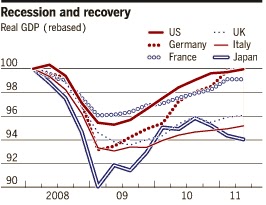
The grim outlook outlined by Martin Wolf in his FT column this week was a stark reminder that economic measurements, while being constructs that usually measure what we want them to, can sometimes not reveal what we want them to reveal.  The example of our definition of a recession is a good example and the one used by Wolf in his column.  By the measures used by the business cycle dating committee of the National Bureau for Economic Research (NBER), the recession ended in June 2009, and yet here we are 24 months later still at real output levels that are below those of the peak of the previous cycle.  The graphic from Martin Wolf's article is reproduced on the left, and shows that US real GDP is still slightly below it's peak in late 2007 and that other countries such as Japan, Italy, the UK and France are also still languishing at output levels way below their peak in the second quarter of 2007.

The fact that the vast majority of the American general public believe that the US economy is still in recession.  According to a CNN poll (see here) only 18% of Americans believe that we are not in recession right now, so this also does not accord with the way that economists measure recessions, and suggests that we might need to review this, or at least re-categorise the phases of the business cycle!


So what should be our measure of a "recession"?  I have heard many commentators say that although we are still not officially in a recession, it sure still feels like one, particularly when unemployment is still high and there are still calls for economic stimulus like the one heard only today from Fed Chicago District President Charles Evans (see here).  But given what has happened in Japan and what appears to be happening in some other developed countries, maybe we should reconsider our definition of recession as a cyclical downturn and recovery up to the point where we surpass the level of real GDP achieved at the peak of the previous boom. In fact with a growing population even this is unsatisfactory because 4 years ago in 2007 the population was smaller than it is today in nearly all of these countries ( - the exception perhaps being Japan) so if we measure output on the basis of output per head of population (or per capita), we would take longer than indicated in the graph above to get to the same level of output per capita so we would be calling the recession over before it really ended. In fact, to be frank I am in favor of changing our definition of a recession because the current measure only focuses on the downturn and does not focus on what happens afterwards - plainly Japan's experience in the 1990s plus our own recent experience suggest that not all downturns are followed by rapid upturns.


All this is even more relevant given the release of the employment statistics on Friday - and the New York Times had a great graph in it's economics top story on the release - an update of the graph originally used by Nancy Polosi to justify the stimulus in the heady first 100 days of the Obama administration back in 2009.  The frightening thing about the graph on the left is that it most clearly shows why this current downturn has been much different from previous downturns. The previous downturn to be matched against the Great Depression was the downturn in the early 1980s where employment fell by 3% from the peak of employment. This last recession caused job losses for way longer than the other recessions ( - in the early 1980s the job losses started turning around after 15 months whereas it took 26 months in this downturn), and way bigger than other recent recessions (over a 6% fall in employment).  The big picture shows that we have only managed to claw back 1% of the loss in jobs, despite economic stimulus and the Fed pumping credit and money into the economy.

I think a much more serious problem is another quite different story that the New York Times (august newspaper though it is) does not bring out in its reporting. If you look at the recessions of the 1970s, 80s and 90s and then the 2 recessions of the 00s, it seems clear to me that the US labor market is much less able to cope with recessions than it used to be - the recovery times seem to be longer and much more drawn out than they were even 20 years ago. To me this implies that there is some very serious changes going on - some of it structural, but I think something must be also be going on in terms of reluctance to hire - for example do companies delay hiring much longer than they used to, asking their current employees to do more overtime for a longer period of time before they decide to bite the bullet?  I'm not sure we know the answers to these questions yet, but clearly things are changing for US workers, and changing fast!  A pretty grim interpretation for the reasons for this are also given today by Robert Reich in the New York Times and although I don't go along with everything he says, I do agree that we need to focus on education, but I would also add that the US really also needs to focus on marketing itself to the rest of the world - countries that sell products to the developing countries (where the economic growth is right now) is one of the best ways to help expand our economy.

So to answer the question I pose for this blog, the response is clearly a resounding "No"! But for all the problems with the labor market ( - and given that it's really no surprise that Obama recently chose a Labor economist, Alan B. Krueger, to head up his economic team), the US has a lot going for it. It has some of the most dynamic companies in the world, and it is far ahead of most countries in the area of technology - but these advantages will narrow compared to Europe and Asia if the US does not focus on what leads to these advantages - education! I think what the US is essentially finding out is that although the military gave you economic power back during the cold war, spending a lot on military does not give you that advantage now. Countries that have focused more on education over the last 20 years (e.g. Finland, Germany, South Korea etc) are now doing very well thank you - countries that have not grown as fast.

What should be done then? I think a good start would be to redefine what a recession is, re-prioritize government spending towards education and away from the military, and to set up some kind of corporate international opportunities bureau which would list foreign opportunities and so US companies would be more aware and able to more easily grasp new overseas opportunities.  

Featured Post

Free Trade on Trial - What are the Lessons for Economists?

This election season in the US there has been an extraordinary and disturbing trend at work: vilifying free trade as a "job kille...

Popular Posts

Search This Blog