Showing posts with label UK. Show all posts

Wednesday, January 10, 2018

Happy New Year for 2018!! Economic outlook and investment strategy

Happy New Year to all my Econoblog readers, and readers through the syndication to Seeking Alpha. As usual, I will try and distill my "top down" macro views for prospects for 2018 in terms of economic growth, the stockmarket, and interest rates.

Backdrop

As we enter the 10th year since the last downturn, the global economy is living on borrowed time - and I mean that literally!  As I explored in my last Econoblog posting (see here), the business cycle is elongating, for either temporary or permanent reasons.  My own predilection is for a permanent elongation (mostly due to the findings from my own academic research agenda), but either way, an elongation is now occurring for this phase of the business cycle as we move into 2018.

So the real question is what will perform best as we move into the late stages of the business cycle expansion, and how to hedge the uncertainty of the coming downturn whenever it is. Well there are several different approaches one can take to answering this question, so I will first do a review of what I see are the prospects for the different regions of the world, and then focus in on what I think makes sense for my own investment strategy.

A quick aside. 2017 has been an exceptional year in the stockmarkets, and the performance of the major stockmarkets in the world has been positive almost everywhere. In the US, the S&P 500 was up 19.4%, the DJIA up 25.1% and the Nasdaq up an astounding 28.2%, while the 10 year US government bond yield is still under 3%.  But although the US performed well, many other countries outperformed the US.  The chart below shows the return of different stockmarkets (in US$ terms), and if we use the S&P 500 as probably the best overall barometer for the entire US stockmarkets, then the US is near the bottom of the list in terms of performance for 2017.
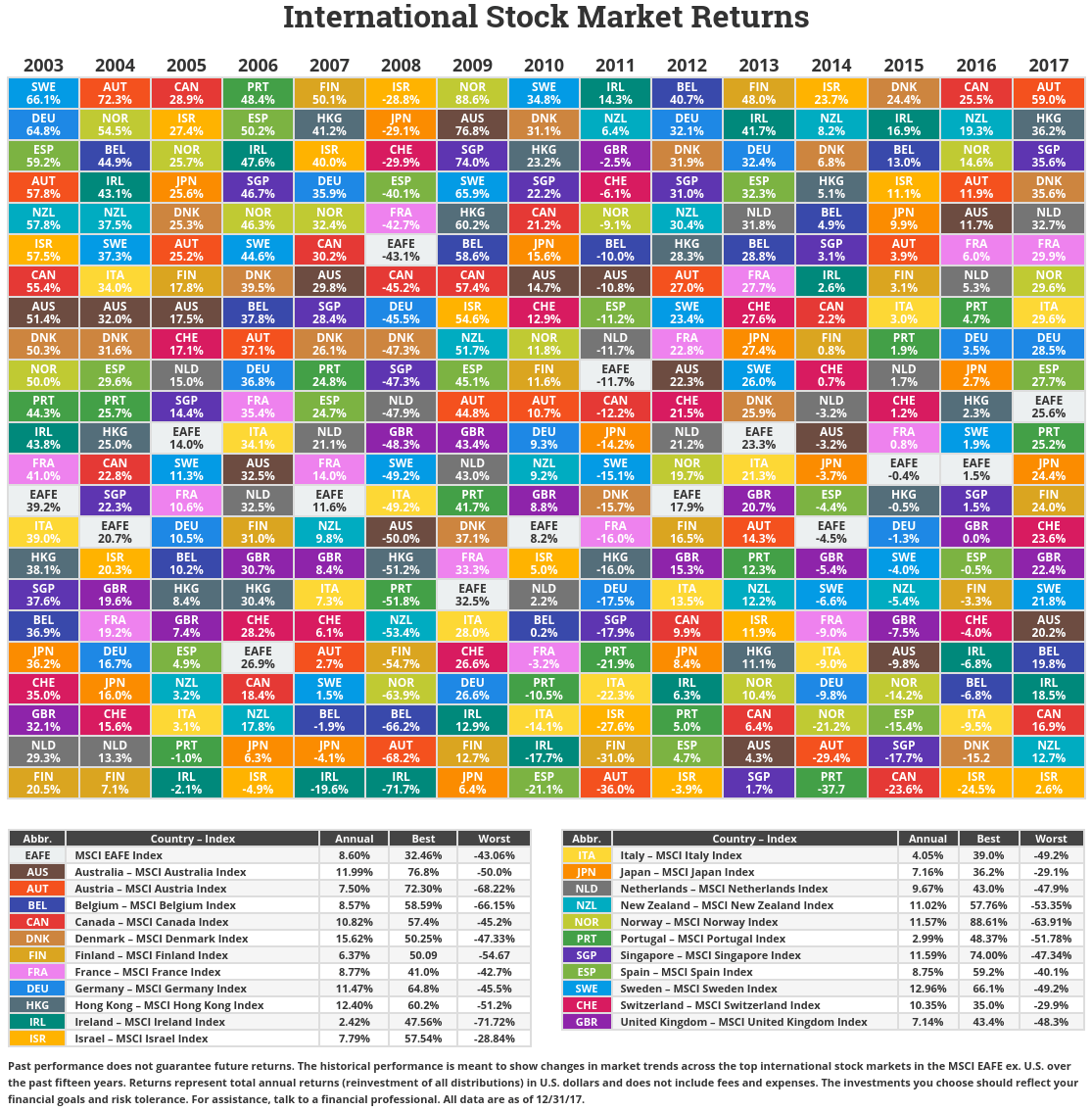
Novel Investor International Markets Returns Table
Source: Novel Investor

But this also doesn't consider other classes of assets, and the website Novel Investor once again has this covered with a chart that shows that emerging market stockmarkets outperformed all other classes of stocks.  This is due to the fact that emerging market stockmarkets have had a fairly tepid performance throughout this business cycle upswing, so in the late stages of the upswing in growth, obviously this will boost commodity prices for many things, which will allow emerging market stockmarkets to outperform.

Novel Investor Asset Class Returns TableSource: Novel Investor

But what of individual emerging markets?  Where performed the best?  Well once again, Novel investor has us covered here too.
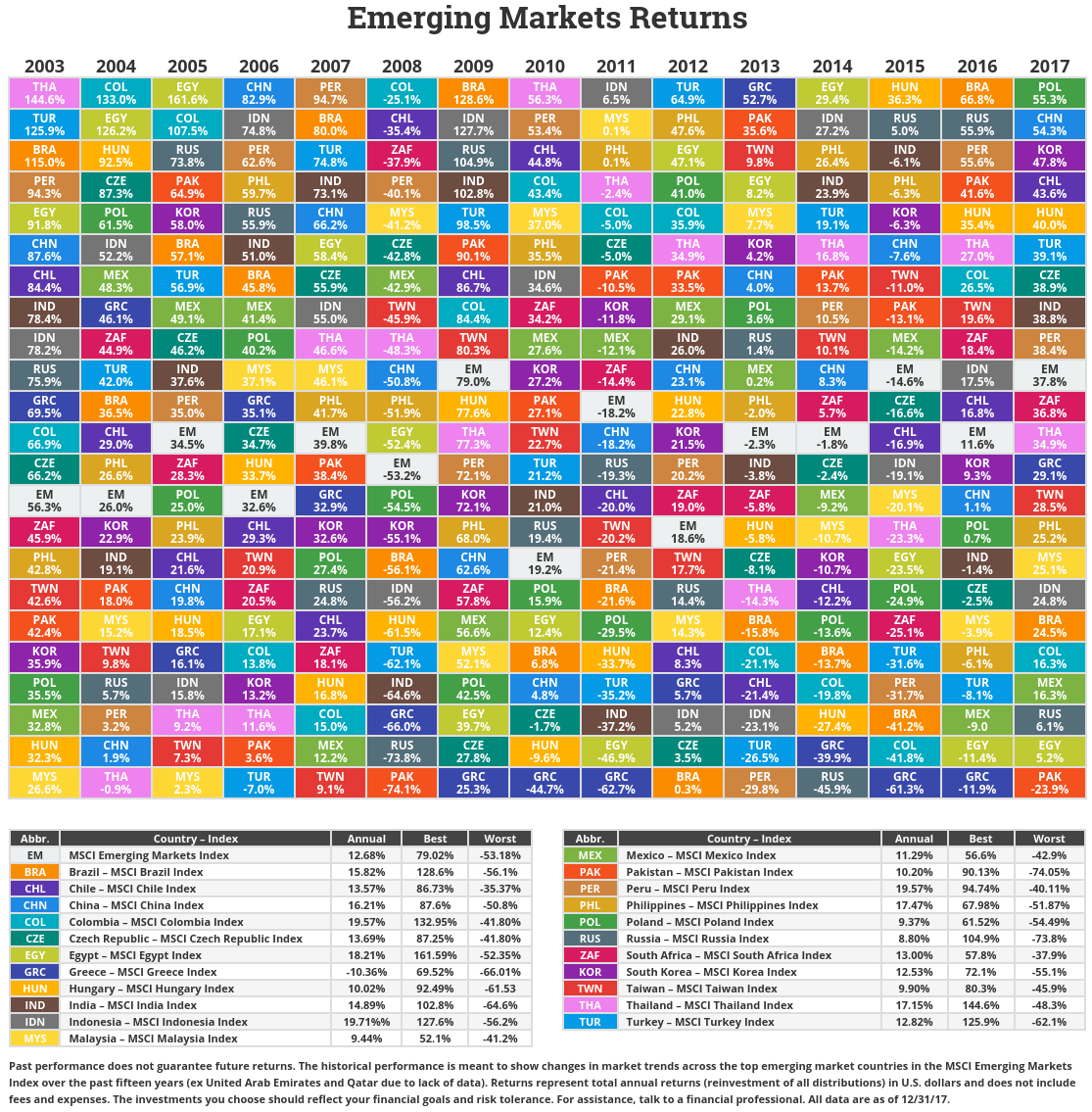
Novel Investor Asset Class Returns Table

Source: NovelInvestor.com

So Poland, China, South Korea and Hungary were the big winners for 2017.  And Pakistan, which several commentators said would perform very well in 2017, was the big loser.  And that really highlights a problem with emerging market economies and individual emerging markets - they are very volatile and it is really a fools game trying to pick which market will be the winner in any particular year.  But there again, that's why anyone interested in investing in emerging markets would be wise to buy an emerging market mutual fund rather than stocks in any individual country.

Back to my thoughts about 2018.  So with the backdrop of the current phase of the business cycle and the fact that US interest rates are likely to rise in 2018, let's look at each region in turn and then devise an economic outlook and investment position for 2018.

North America


The US has had a great run in 2017, but with rising rates, and an erratic President, with the good news for US corporations now delivered in terms of the tax reform, further progress with President Trump's agenda will be difficult.  The President will need cooperation from democrats if he is to pursue his plans to pass an infrastructure spending package, and the impasse on immigration doesn't seem to bode well for cooperation in that or in any other area for that matter.  So I can only conclude that most of the good news for stocks has already now been achieved, and there will be little more coming down the pipeline.  If there is more and I am wrong, then clearly the infrastructure and construction companies will do well.  Given the political uncertainty in the US surrounding the mid-term elections and the ongoing investigations together with rising interest rates and withdrawal of QE, I think the US will underperform compared to other parts of the developed world and certainly with respect to the emerging markets.

I think NAFTA will likely collapse in 2018, which will mean that Mexico is probably not a stable place to invest, but Canada will likely outperform both the US and Mexico, given that the US has made it clear that if NAFTA is terminated, then the US would still be open to falling back to the original CUFTA trade deal that was the precursor to NAFTA.  So in general, I think that Canadian stocks are a safer bet than US stocks for 2018 and should be bought on any signs of weakness.

The other factor that has had very little press so far this year is that yes, we have a new Chair of the Fed, Jay Powell.  As with all Fed Chairs, Jay is likely to have an early stumble or mishap in the job as he finds his feet.  That may unnerve the markets as well.  I would expect that maybe the FOMC might act too aggressively to increase rates than is necessary, or may "fall behind the curve" at some point.  Either way, there are clearly consequences for the stockmarkets here.

The US dollar is also a bit of a conundrum for 2018.  Rising interest rates usually portend a stronger currency, and that's what we have seen so far but with the protectionism proposed by the Trump administration and the possibility that the Chinese may no longer buy so many bonds, that in turn will have an uncertain effect on the currency.  As can be seen from the plot of the trade weighted US dollar, despite the recent depreciation, we are close to all time highs already.  Obviously from international economics that means that the markets have already discounted further rate rises, and are perhaps now looking for reasons not to push the US currency any higher.


Europe

European stockmarkets generally had a great year in 2017, and as QE continues in 2018, it is likely that this will continue at least until the second half of the year.  If you look at the performance of the European stockmarkets in recent years, they nearly all had downturns in 2014 and/or 2015, so they are basically still catching up with the US, and of course the banking sectors in the EU are still fragile but improving as time goes on.  The Mifid2 directive, which was supposed to come into force at the beginning of this year will likely (when implemented in March) increase transparency and efficiency in EU stockmarkets which will tend to increase confidence and spur greater stockmarket returns.

The two areas where there are significant risks are Brexit and Greece.  With Brexit, there is no certainty yet that a trade deal between the UK and the EU will be achieved before the exit date of March 2019.  Although Prime Minister Theresa May has successfully concluded the conditions of the breakup by agreeing to a hefty payment to the EU and safeguarding the right of EU nationals to remain in the UK after March 2019, this does not ensure that a trade deal will be struck in time.  The current policy of "gradual divergence" (see here) does not bode well for a consensus on any new trade deal as the EU does not see this as consistent with having a trade deal that would create a level playing field between the UK and the EU - it is seen as cherry-picking the areas where the UK would not want to diverge for fear of losing business, while having the right to diverge in other areas.  Also the Chancellor, Philip Hammond, who is much more in favor of a "soft" Brexit, has broached the idea of a new customs union with the EU (see here), but this would not allow the UK much independence when negotiating trade deals with other countries as the UK's hands would already be tied in relation to trade policy because of the EU customs union.   The second area of risk remains Greece.  Greece is now experiencing growth again, but the political situation is still not completely stable, as an elections must be called by October 2019, and the current government is unlikely to want to wait that long, so a general election is likely to be called in the second quarter of 2018.  The outcome of the election is likely to determine whether Greece continues to follow the path of fiscal consolidation insisted upon the rest of the EU, or a new government pushes the country in a different direction.

From an investment standpoint probably the Nordic countries are most insulated from these risks, although probably Central and Eastern Europe stockmarkets are still likely to be the most volatile and may yet again outperform the Western and Southern European member states.

Japan

The news from Japan has basically been good in 2017.  The efforts to stimulate the economy using QE appear to be now paying off, with economic growth now positive for the 7th consecutive quarter (see here), but mostly due to external factors rather than domestic growth ( - consumption was still in decline in the last quarter reported).  Nevertheless recent revisions to 3rd quarter GDP suggest that the economy was growing faster than previously thought, which allowed the stockmarket to remain buoyant, but it does mean that without the external demand stimulus and the continuing QE, the economy would likely have experienced only tepid growth.

The Japanese economy therefore does appear to have achieved "escape velocity" which means that deflation is now in the rear view mirror, despite the fact that inflation is still falling short of the Bank of Japan's inflation targets.  This should allow the Japanese stockmarket to make further gains in 2018.  In fact, if correct, a recent FT article (see here) suggests that the labor market is now in a state of severe shortage, which should allow wages to start to rise in a more sustained.  That, in turn, will boost the stockmarket.

Rest of Asia

My views on China are relatively well known after my recent presentation on OBOR (One Belt One Road).  But to recap, I think that China will grow in 2018, but substantially less rapidly than it did in 2017 as OBOR projects take production out of the country ( - remember that GDP only includes production within the borders of a country).  OBOR is clearly long term geopolitical and economic investment project, so it is expected that GDP would slow...GNP, on the other hand, will stay relatively robust.  Anyone who has been to China can attest to the fact that although investment is still high, it is clearly slowing as there is now a substantial amount of "infrastructure slack" in the economy ( - visible in terms of "ghost" trade and logistics inland ports, empty buildings and relatively empty new highways and fast speed trains out in the rural west).  And although consumption is now clearly on display in the major cities, I think that China's next push must be to modernize it's agricultural sector based in the rural areas, and that will not be easy.

As for India, 2017 was quite rocky (what with the monetary reforms and the unpopular new VAT tax), but as long as tinkering with major part of the macroeconomy do not continue under the Modi government, the prospects for an uptick in growth appear quite good.

Africa

The election of Cyril Ramaphosa as ANC Chair and therefore leader of the party, caused a relief rally
in late 2017, and I believe this will continue through 2018, with much more business friendly approaches making an appearance in South Africa and hopefully a more pragmatic approach to achieving the lifting of all boats through more sensible economic policies for the whole economy will start to bear fruit.

Investment Strategy

So given my macroeconomic views detailed above, what does this imply about investment strategy?  I have produced the cyclically adjusted price to earnings ratios (CAPE ratio) for all the countries discussed above in the figure below.  The data ends in November of 2017, so although we are missing one datapoint it is clear that the US has, since early 2016, had the highest CAPE.  That means that the US firms' stockmarket prices were highest compared to their earnings at this stage of the business cycle.  Then comes Japan, which is not far behind.  At the bottom of the CAPE rankings are UK and China, while the countries sandwiched in the middle are India and collectively the European countries. 


Source: http://shiller.barclays.com/SM/12/en/indices/static/historic-ratios.app
But what does that mean then?  I think what it means is that stocks in both China and the UK are valued at roughly half the amount that US and Japanese stocks are.  That in turn tends to suggest that i) if stockmarkets globally continue to climb, it is likely that those with lower CAPEs will grow faster than those with higher CAPEs; and ii) that if there were to be a pullback, the amount of the pullback is likely to be less in both the UK and China simply because those two markets have not climbed to nearly the same levels as have both the US and Japan.

So for an investment strategy based around the viewpoint expressed here, I would suggest:
i) underweight on US and Japanese stocks
ii) overweight on UK and Chinese stocks
iii) some weight in India and European stocks
iv) underweight on US government bond holdings
v) overweight on foreign bonds, particularly of those countries where China might want to substitute  holdings.
vi) overweight on other EM stocks, as these countries try to catch up with the phenomenal pick up in the US stockmarket.

And yes, I have already rearranged my own portfolio to put my proverbial money where my mouth is!





Monday, January 4, 2016

My thoughts on economic prospects for 2016

Welcome to 2016, and of course a very Happy New Year to all my blog readers!  As usual at this time of year, I like to reflect on the events of 2015 and what 2016 might bring in terms of the global macroeconomy and the capital markets in general.

So let’s start our global tour by first looking at the US. 2 factors were surprising in 2015: firstly the continuing fall in oil prices down to the mid-$30s – of course the fall started in 2014 but it has continued to fall as OPEC’s indecision has weighed on the oil markets; and secondly, the lack of any Fed tightening until December, despite the fact that there were expectations that rates would rise much earlier in the year.  All this suggests that growth in the US will, if anything, accelerate in 2016, and it implies that the US economy will continue to perform well as the country settles into the later part of the business cycle. Although some regard 2015 as a lackluster year, the markets are really not a good reflection of the surprising resilience of the US consumer, who is not only saving more, but also is spending more, but notably on different types of products than previously.  In particular, the tech sector still has strong potential growth given that this remains a comparative advantage for the US, and the housing sector continues to perform well, as the demand for housing is still masked by unreasonably strict credit conditions and the fact that ageing boomers are living longer and therefore inheritances are being delayed to the younger generations.  The Biotech sector has had a miserable year in terms of stockmarket performance, and this will likely continue and if anything worsen until the US elections are over, as drug pricing remains a politically divisive issue.  

In terms of the increase in interest rates, the Fed has made it clear that it will likely hike rates 4 times next year, which, as I stated in my last blog, likely reflects the fact that the Fed wants to normalize and realizes it has fallen behind the curve in terms of adjusting rates to appropriate rates ahead of the next downturn in the economy.  In other words, the Fed has prioritized rate hikes over withdrawal of quantitative easing (QE), which still leaves a lot of extra funds sloshing around the financial system.  Most financial market economists have forecast fewer rate hikes, and therefore little likelihood that the US dollar will further strengthen, but I think that this is a mistaken view – the Fed knows that January 1st sees a raft of increases in minimum wages across the country, and so wage pressures are picking up, which coupled with extremely loose monetary policy implies that inflation pressures will likely build in the US economy, which will justify the rate increases, plus the fact that the QE will still largely be in place will also continue to act as an economic stimulus.  The wild card here though is the US dollar, which could appreciate, capping any inflationary pressure due to import price pass through to items like clothing and retail items, and also putting further dents in export performance by US multinationals. Any fall in the US dollar would therefore work in the opposite direction – to likely stimulate exports, adding to economic growth, but raising import prices thereby leading to greater certainty regarding Fed interest rate hikes.  Another potential factor stimulating the US economy will be largely dependent on Congress going forward – the Trans-Pacific Partnership or TPP.  If this does get passed by Congress and signed into law, the impact could be significant in the latter part of 2016. 

Next, let’s move on to Europe.  For 2015 Europe has had a good year in economic terms, with the exception of a few countries (for example Greece and Portugal), but near all-things non-economic in Europe have not gone according to plan in 2015.  The reason for the good news is largely down to the ECB and Mario Draghi’s “whatever it takes” QE, which has spurred stronger economic growth in the euro area core and periphery, giving stockmarkets such as Germany’s and Ireland’s a pretty good year.  The depreciation of the euro appears to have had little effect on import prices, largely because any increase in non-oil import prices has been more than offset by the (much) lower oil and other commodity prices. This is the reason that I have heard many economic commentators say that Europe is now “mid-cycle” compared to the US’s “late-cycle” position, but I think that although Europe lags behind the US in terms of business cycles, there is an “international business cycle” effect which does tend to tie Europe closely to the US business cycle – in other words, I think that Europe, although it has struggled to record significant economic growth rates, still only lags marginally behind the US in terms of its (natural) business cycle.  Given the ECB’s continuing stimulus through QE, the less fiscally profligate economies in Europe will continue to do well in 2016.  On the Transatlantic Trade and Investment Partnership (T-TIP) with the US, I think this will get put on hold in 2016, given the Presidential elections.

One side note on Europe here concerns the UK in 2016.  In the UK, there is a referendum planned on continuing membership of the European Union (EU) in June, in which Prime Minister David Cameron will make the case for sticking with the EU (but continuing to stay out of the euro). There are various forces in the UK now aligned against continuing membership of the EU – that is one reason why the UK stockmarket is down for 2015 when most EU stockmarkets are up over the same year.  Obviously the outcome of this referendum on the EU will colour the performance of the UK economy and of the UK stockmarket in 2016.

The Japanese economy saw continued signs of response from the QE being tried there by Prime Minister Shinzo Abe, but the US dollar’s strength coupled with the yen’s weakness meant that unhedged returns were muted, despite the fact that the Nikkei was up by over 9% last year.  Given the continuance of QE in Japan and Abe’s reforms, Japanese growth should be positive again, and that should lead to further stockmarket gains, although the direction of the currency is less certain in 2016, as the yen is now seen as more of a “safe haven” currency, and could be buoyed by inflows from China.

Turning to China, although markets there were positive over the previous year (up over 9%), the continuing devaluation of the yuan will sap confidence over “directed” economic policy.  Furthermore, as global growth will be under par as a whole, China will continue to slow, and this will be reinforced by the collapse in Chinese investment. I would expect the Chinese stockmarket could be down significantly in 2016, particularly if the Chinese government does not stimulate the economy.  In India, if Modi can continue to push through meaningful reforms, then the stockmarket could be one of the better performers in 2016.

Other than the major economies already covered above, I believe that unless there is an escalation conflict in the Middle East, oil prices will continue to be extremely low in the first part of 2016 and may move even lower than the high $30s, but in the second half of the year, there will be some rebound in prices as bankruptcies in the US leads to less supply on world markets.  In terms of commodity prices, they will continue to be weak into the first half of 2016, but once again, there could be some rebound in the second half as there is “overshooting” which leads to bankruptcies in this sector.  

Tuesday, June 2, 2015

Greece needs to leave the euro: Part I

I wrote this comment in reply to a great article published by Martin Wolf in the FT today (6/3/2015) which you can find here 

__________________________________

Good article, but in my humble opinion some misconceptions.  


First, Martin Wolf makes the point that the euro area is not an OCA.  As my research has clearly shown (see my Bank of Finland discussion paper on this issue published 2 years ago  http://www.suomenpankki.fi/en/julkaisut/tutkimukset/keskustelualoitteet/Pages/dp2013_33.aspx), Greece does not have, and never did have, business cycles (or any other cycles for that matter) that are synchronous with the rest of the euro area.  It is simply not a good fit with the rest of the euro area, without (according to the OCA theory) there being sizable offsets which consist of fiscal transfers and much higher labor mobility.  And this is the case both ex-ante, and ex-post.  So, given this empirically proven stylized fact:

Second, the Greek government is simply wasting it's time and energy negotiating something that will not result in any long term membership of the euro - it will just be "another shot of medicine to help the dying patient".  I understand that the fact that the Greek government is actually negotiating is a necessary political pre-requisite to leaving the euro, but let's not drag this sorry Greek tragedy on any further than needs be, as this just prolongs and likely exacerbates the suffering of the Greek people.  

Third, Martin Wolf says that this will have a profound effect on the euro area and reverse the integration dynamic.  Well, hmmm, Greece is a little country the size of the State of Rhode Island in the context of the US - so it's not as if Spain or Italy were leaving. The euro area is 16 years old - and so its longevity won't depend on one small member deciding to leave early on it's evolution.  Also, the UK leaving the EU would have a much bigger impact on the integration dynamic than Greece leaving the euro area. 

Lastly, Wolf clearly wants Greece to stay inside the euro when he says that "This must be seen as a long game".  I mean how long do you want this game to be?  Governments simply don't think long term as their time horizons are short term or medium term at best. So the Syriza government really has the choice of alienating it's supporters and signing up to something that it promised never to sign up to, or pulling Greece out of the euro, which will create some chaos to begin with unless they have a proper plan B in place.  

If I were the Greek finance minister right now (which thankfully I am not), I would be furiously planning and comparing different strategies for a euro exit, as inevitably, that's what is the most likely outcome here.  
_______________________________________

Now in part 2 of this blog, which will come out in the next couple of days, I will outline what I think the options are for Grexit.

Saturday, January 3, 2015

The Global Economy in 2015

Happy 2015 to all my Econoblog readers!  I spent NYE in London by Tower Bridge enjoying a distant view of the spectacular fireworks display (see image on left) that London put on this year ( - but for the first time with a charge for the best viewing spots). Being in London certainly gives you a reminder of how globalized the world has become, as I heard at least 10 languages being spoken in the space of one particular day there. And of course these days the global economy is interconnected as never before with people and funds flowing freely across borders. A few years ago, when we hit the "great recession", there was talk of the reverse of globalization, and although some firms might have pulled back from such a large commitment of resources to international projects and expansion, I believe that this was only a lull, and not a reversal. Today, I was greeted in a British restaurant by a Danish front of house manager, served by a waittress from the Czech Republic and my table was cleared by a Hungarian. This would be almost unimaginable even ten years ago.

The reason why I bring this up is that I believe that the state of the global economy and trends at the global level are very important.  Paul Krugman also emphasized this in his most recent blog (see here) which shows that recent trends have basically transferred income from the developed country working classes to the developing country middle classes (in countries such as China and India). But those are long term trends, trends that will continue slowly over future decades.

Our focus here is what really matters in 2015. In my previous blog posting (see here), I have made the case that oil prices will stay reasonably low for at least 18 months, so that for the most part of 2015 oil prices will not be on an increasing trajectory.  So let's deal with each continent in turn.

Source: Wall Street Journal, Jan 2, 2015
In North America, the Fed has said it will begin to tighten, but will only do so slowly, which means that growth will accelerate here, leaving the Fed further behind the curve, as lower oil prices give a deflationary impulse to the CPI until the end of June.  This will allow the housing market to properly recover, as even with the upward move in interest rates, the amount of the rise will be relatively small, leaving mortgage rates still close to historic lows. In my view, this, coupled with the relaxation of mortgage conditions, will lead to increased demand for mortgages as rental rates are now very high compared with costs of home ownership. That means that although a very modest rise in interest rates will occur, it will still allow strong growth, falling unemployment and a buoyant stockmarket, with the retail and technology sectors doing particularly well.

In Europe, Greece remains the big problem. The "renegotiation of austerity" promised by the leftist party there, Syriza, led by Alexis Tsipras, has already sparked major fears in Europe of a showdown over the so-called Stability and Growth pact and the economic pain and suffering it has inflicted upon Greece. Although an exit from the euro (or "Grexit") has apparently been taken off the table for the moment ( - perhaps to make the leftist coalition more electable?), there is no reason why it could not be put back on the table once Syriza is in a position of power. That would leave the EU with a very interesting problem: do they make concessions to the Greeks and risk having the Portuguese, Spanish and Italians insisting on similar loosening of fiscal austerity conditions?  Or do they just allow the Greeks to then openly talk about exit from the euro, with all the instability that that would cause. Clearly, until the Greek situation is resolved, the uncertainty in Europe will prevent the euro area from emerging from its economic torpor anytime soon.  This means that the euro will remain under considerable pressure.

On monetary stimulus in the euro area, I think that Mario Draghi will continue to try and talk the euro area out of a mild recession, but there is just no consensus on how to do a really large and effective QE in Europe (despite what the pundits say -see here on this), so that although the limited measures still in place in Europe will continue, and may be expanded, no dramatic new programs will be announced unless things take a serious turn for the worse.  Worse here means either deflation appearing or a Grexit occurring and other member states threaten to leave the euro area. This is not beyond the realm of possibility, given that Germany it appears, thinks that the euro area could cope with a Grexit (see here).

The situation in the UK in particular, will also be rather uncertain in 2015.  Elections will occur in May of 2015, and there is considerable uncertainty as to which party or parties will take power. This means that the pound could depreciate in the first part of the year, and then could depreciate further in the second part of the year if a Labour government is formed, or rebound if some form of Conservative government is elected. The Bank of England will only change interest rates in the second half of the year, depending on how fiscal policy changes after the elections. Nevertheless, the UK should have accelerating economic growth as house prices continue to rise in the London area, and the wealth effect takes hold inducing higher levels of spending.

Source: http://krugman.blogs.nytimes.com/2015/01/02/britains-success-story/
The chart above to the left shows how the UK has fallen behind both the US and France due to the austerity measures imposed by the Conservative-Liberal coalition government. The trajectory shown in the figure though suggests a rate of growth of income in the UK similar to that in the US has now emerged. Note how weak income growth is in France though. Both Italy and Spain are experiencing worse rates of economic growth, which gives you a picture of how bad things are right now in the euro area.

Done by author: Data sourced from BoJ and FRED

In Japan, Abeonomics has not really yielded results yet, but there are promising signs that with the hefty new QE announced late last year that Japan's economy will finally emerge from the deflationary slump it has been in over the past couple of decades.  Unfortunately though the other half of the sales tax hike should moderate any uptick in growth coming from the monetary side, which means that even though a new stimulus package was unveiled in Japan on Dec 27th (see here), with a public debt to GDP ratio just under 250%, there is really very little room for any more action here. What is more promising is that there might be further monetary stimulus, which in my judgement is still needed to really get us on a path to achieving the Bank of Japan's 2% inflation target.  The chart on the right above shows that in fact although base money has been significantly stimulated by qualitative and quantitative easing (QQE) in Japan, M2 as a % of GDP appears to have now bottomed in the first quarter of 2014 (right hand axis, in %), and so although real GDP growth is still negative (left hand axis in YOY growth in % using seasonally adjusted data), there appears to be dogged determination by the central bank governor, Haruhiko Kuroda, to stimulate the economy by QQE until Japan finally starts moving in the right direction again. In my view perhaps in 2015 the QQE monetary stimulus may finally have some tangible effect, as expectations of the general public and the financial markets begin to change.

As for the rest of Asia, I see the Chinese economy still growing at a rapid clip, but until the euro area recovers (as it is the biggest customer for the Chinese), the Chinese economy will still have some headwinds. India is probably the most interesting place to invest in Asia right now, although of course whether Narendra Modi can actually achieve the reforms that he wishes to put in place, given the fractious nature of democracy in the country, is anybody's guess. But the potential is nevertheless there, with India now starting to emerge out of the shadows I believe that India will begin to catch up with China in terms of its economic growth trajectory.

In the rest of the world, I think Africa's economy will improve in 2015, as will that of South America, given that 2014 has delivered some hard lessons in how governments and political ambitions can often interfere with delivering and then maximizing economic growth.  

Friday, December 16, 2011

Euro area: a strained future


So here we go again – in light of the ongoing and seemingly intractable European crisis, we seem to be back looking at fiscal policy again, and from my vantage point it’s a mess.  After trying to revamp the Stability and Growth pact (SGP) in the first year of the euro area crisis, Angela Merkel and Nicholas Sarkozy (what the FT is calling the “Merkozy” factor) are now embarked on proposing a “fiscal compact” with stiff and rapidly imposed penalties on errant member states - and of course because the Stability and Growth pact had no real legal status as a series of accords ( - they merely clarified the excessive deficit procedure), it’s fines were never taken seriously.  And in any event the member states most in trouble right now would not be subject to the SGP because they are either in recession (Greece), or are running primary surpluses or close to them (Italy, Ireland and Spain). 

In one respect the prospect of a “fiscal compact” I thought would be good: it would finally get rid of the (“stupid”) SGP and move us towards something more sustainable (and hopefully properly designed) for euro area fiscal policy. How disappointing then to find that although (or perhaps because) the announcement of the new “fiscal compact” was made quickly, it’s form is little different from the original SGP except that it will now be enshrined in national laws and have more immediate and harsher consequences. This is extremely disappointing as I know that the Commission has been looking at alternative fiscal policy measures such as debt measures, and yet the Commission was obviously either reticent or was ignored by the French and the Germans when it came to drawing up the outline for a “fiscal compact”.   

In economics we distinguish between stock and flow variables – flow variables being measured over time while stock variables are measured at a point in time.  Clearly the government budget balance is a flow variable as it measures the government finances over a period of time whereas the government net debt measure is a stock variable as it measures how much is owed to non-governmental entities at a point in time. The “fiscal compact” is once again going to focus on the budget deficit, and in “structural terms” ( - that is, adjusting for the position in the business cycle, an uncertain and inaccurate adjustment given our knowledge and ability to pinpoint where an economy is in the business cycle). From an economic perspective it would have been so much more sensible to focus on net debt as this is what the market reacts to.  You cannot adjust net debt for the position of the economy in the business cycle as it is a stock variable and so one could have imagined warning limits on debt levels and then a trigger level where budget surpluses would have to be run if a specific level is breached. Moreover as economic growth affects the level of sustainable debt that could be managed ( - because it is the net debt to GDP ratio that really matters), then obviously one could also imagine a scheme whereby slow growing economies would have lower debt limits than higher growth economies in Europe.  This is an important issue as the desirability of joining the euro will be limited in Central and Eastern Europe if it limits growth prospects.

This SGP design flaw of focusing on the budget deficit is therefore going to be carried forward into the “fiscal compact”, and the only reason I can detect for doing this is the urgency of doing something quickly and also the political difficulty in coming compromising on some new economic measure which countries should focus on – a measure that would likely cause consternation in Belgium and Italy, two countries that are considered part of the “core”, but would definitely be penalized and have to embark upon more serious austerity measures.

The whole reason for this “compact” was to trigger some offset from the monetary policy side, and ultimately for the longevity of the euro area Eurobonds must be issued for the euro area as a whole but Chancellor Merkel could not allow this to be formally agreed to at the summit as this would imply that the central bank in charge of the euro is no longer independent.  Although it is unimaginable that ECB President Mario Draghi would allow the euro area to collapse ( - why would the President of an independent inter-governmental institution allow the whole reason why the bureaucracy exists to disappear?), he is going to have to make some kind of commitment in response to the fiscal rectitude about to be heaped on much of the euro area.  And that response, in my view, is key. It is likely only to be given behind closed doors, and will add an additional dimension to future horse-trading between member states.  Clearly if the ECB makes assurances now, the fiscal measures will be weaker than they otherwise would have been, so the ECB has no incentive to make any announcement until the ink dries on the new inter-governmental treaty.

Two other observations.  First, the assumption that all EU member states should be assumed to be on a track to adopt the euro should be dropped.  It is clear now that the Maastricht criteria were partly flawed (certainly the fiscal criteria are), and given the recent problems with the euro area it would make sense to allow member states to join when they are (or think themselves) ready to join.  The 60% of GDP debt and 3% deficit criteria need to taken out of the entry criteria and replaced with something more like whatever the “fiscal compact” eventually turns out to be. 

Second (and hopefully you read it here first), the UK is now widely expected to go into a second recession in 2 years.  This highlights the problem that all policymakers have (both in the US and the euro area) – that is essentially one of keeping on the right side of the financial markets while stimulating the economy, and properly coordinating both fiscal and monetary policy to ensure the best outcome.  While Cameron antagonized the Europeans, he is not exactly proving to be a good economic steward at home with the City of London likely shrinking during 2012, with a consequent drop in UK house prices.

Featured Post

Free Trade on Trial - What are the Lessons for Economists?

This election season in the US there has been an extraordinary and disturbing trend at work: vilifying free trade as a "job kille...

Popular Posts

Search This Blog