Showing posts with label Japan. Show all posts

Wednesday, January 10, 2018

Happy New Year for 2018!! Economic outlook and investment strategy

Happy New Year to all my Econoblog readers, and readers through the syndication to Seeking Alpha. As usual, I will try and distill my "top down" macro views for prospects for 2018 in terms of economic growth, the stockmarket, and interest rates.

Backdrop

As we enter the 10th year since the last downturn, the global economy is living on borrowed time - and I mean that literally!  As I explored in my last Econoblog posting (see here), the business cycle is elongating, for either temporary or permanent reasons.  My own predilection is for a permanent elongation (mostly due to the findings from my own academic research agenda), but either way, an elongation is now occurring for this phase of the business cycle as we move into 2018.

So the real question is what will perform best as we move into the late stages of the business cycle expansion, and how to hedge the uncertainty of the coming downturn whenever it is. Well there are several different approaches one can take to answering this question, so I will first do a review of what I see are the prospects for the different regions of the world, and then focus in on what I think makes sense for my own investment strategy.

A quick aside. 2017 has been an exceptional year in the stockmarkets, and the performance of the major stockmarkets in the world has been positive almost everywhere. In the US, the S&P 500 was up 19.4%, the DJIA up 25.1% and the Nasdaq up an astounding 28.2%, while the 10 year US government bond yield is still under 3%.  But although the US performed well, many other countries outperformed the US.  The chart below shows the return of different stockmarkets (in US$ terms), and if we use the S&P 500 as probably the best overall barometer for the entire US stockmarkets, then the US is near the bottom of the list in terms of performance for 2017.
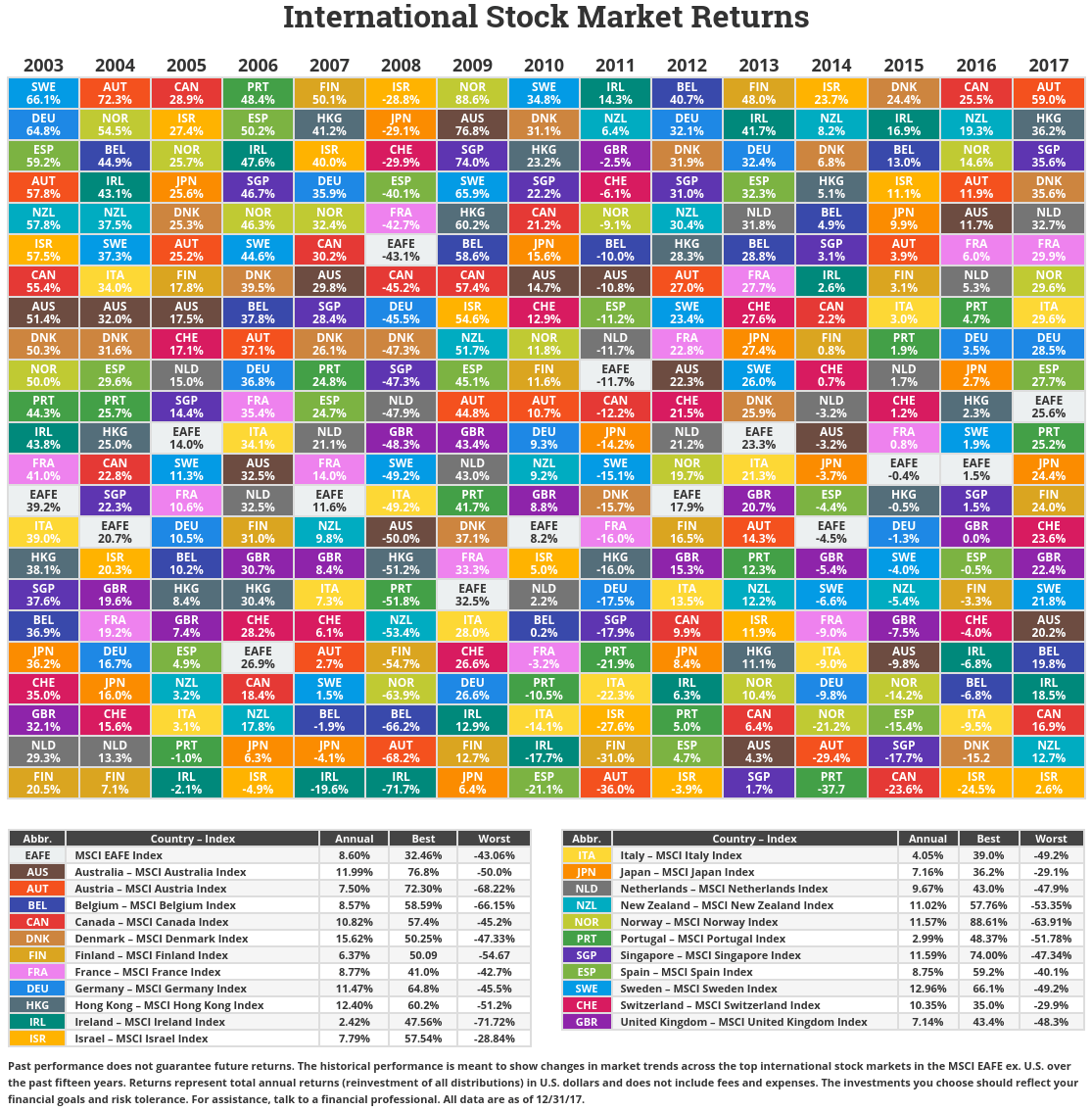
Novel Investor International Markets Returns Table
Source: Novel Investor

But this also doesn't consider other classes of assets, and the website Novel Investor once again has this covered with a chart that shows that emerging market stockmarkets outperformed all other classes of stocks.  This is due to the fact that emerging market stockmarkets have had a fairly tepid performance throughout this business cycle upswing, so in the late stages of the upswing in growth, obviously this will boost commodity prices for many things, which will allow emerging market stockmarkets to outperform.

Novel Investor Asset Class Returns TableSource: Novel Investor

But what of individual emerging markets?  Where performed the best?  Well once again, Novel investor has us covered here too.
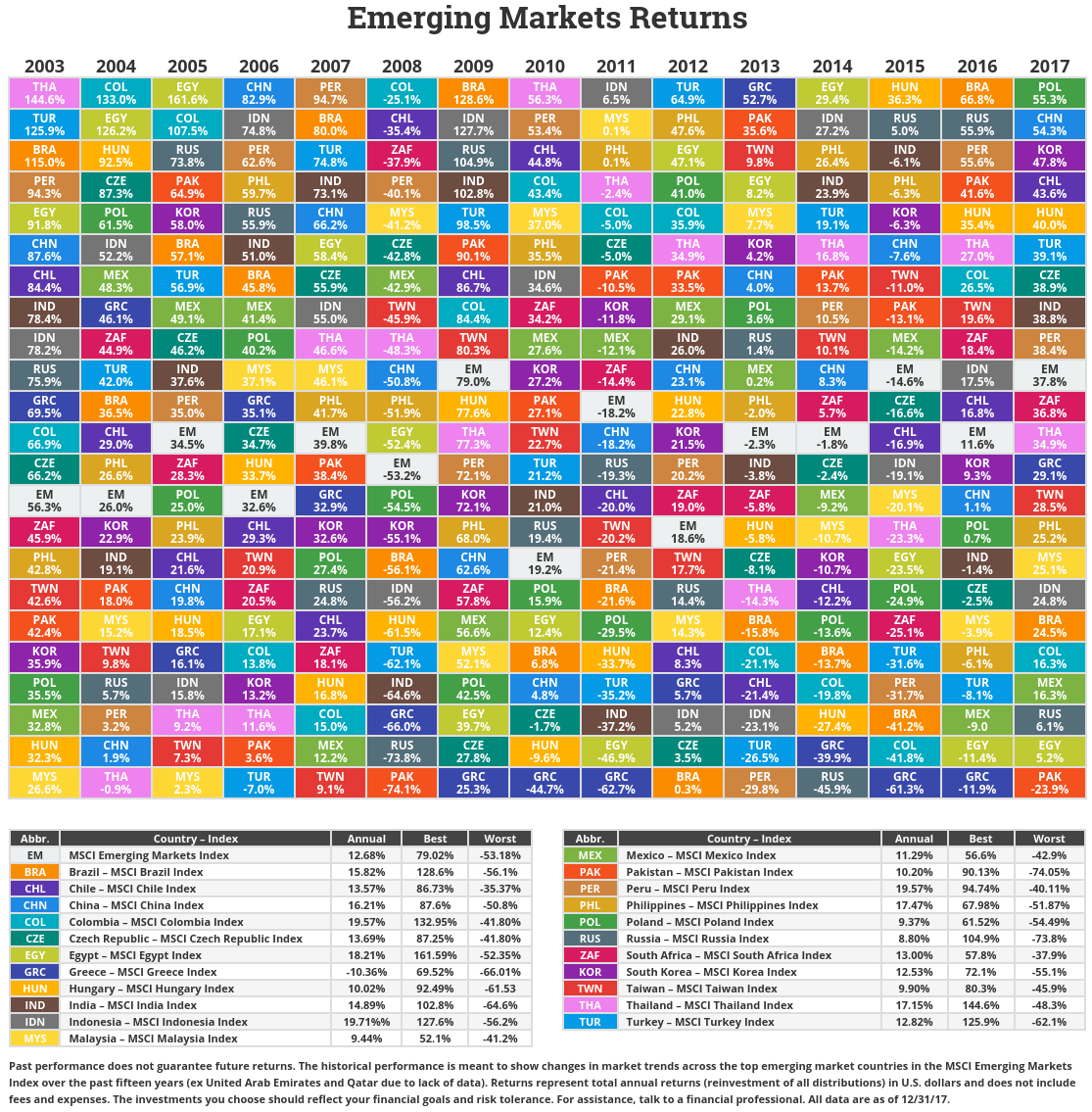
Novel Investor Asset Class Returns Table

Source: NovelInvestor.com

So Poland, China, South Korea and Hungary were the big winners for 2017.  And Pakistan, which several commentators said would perform very well in 2017, was the big loser.  And that really highlights a problem with emerging market economies and individual emerging markets - they are very volatile and it is really a fools game trying to pick which market will be the winner in any particular year.  But there again, that's why anyone interested in investing in emerging markets would be wise to buy an emerging market mutual fund rather than stocks in any individual country.

Back to my thoughts about 2018.  So with the backdrop of the current phase of the business cycle and the fact that US interest rates are likely to rise in 2018, let's look at each region in turn and then devise an economic outlook and investment position for 2018.

North America


The US has had a great run in 2017, but with rising rates, and an erratic President, with the good news for US corporations now delivered in terms of the tax reform, further progress with President Trump's agenda will be difficult.  The President will need cooperation from democrats if he is to pursue his plans to pass an infrastructure spending package, and the impasse on immigration doesn't seem to bode well for cooperation in that or in any other area for that matter.  So I can only conclude that most of the good news for stocks has already now been achieved, and there will be little more coming down the pipeline.  If there is more and I am wrong, then clearly the infrastructure and construction companies will do well.  Given the political uncertainty in the US surrounding the mid-term elections and the ongoing investigations together with rising interest rates and withdrawal of QE, I think the US will underperform compared to other parts of the developed world and certainly with respect to the emerging markets.

I think NAFTA will likely collapse in 2018, which will mean that Mexico is probably not a stable place to invest, but Canada will likely outperform both the US and Mexico, given that the US has made it clear that if NAFTA is terminated, then the US would still be open to falling back to the original CUFTA trade deal that was the precursor to NAFTA.  So in general, I think that Canadian stocks are a safer bet than US stocks for 2018 and should be bought on any signs of weakness.

The other factor that has had very little press so far this year is that yes, we have a new Chair of the Fed, Jay Powell.  As with all Fed Chairs, Jay is likely to have an early stumble or mishap in the job as he finds his feet.  That may unnerve the markets as well.  I would expect that maybe the FOMC might act too aggressively to increase rates than is necessary, or may "fall behind the curve" at some point.  Either way, there are clearly consequences for the stockmarkets here.

The US dollar is also a bit of a conundrum for 2018.  Rising interest rates usually portend a stronger currency, and that's what we have seen so far but with the protectionism proposed by the Trump administration and the possibility that the Chinese may no longer buy so many bonds, that in turn will have an uncertain effect on the currency.  As can be seen from the plot of the trade weighted US dollar, despite the recent depreciation, we are close to all time highs already.  Obviously from international economics that means that the markets have already discounted further rate rises, and are perhaps now looking for reasons not to push the US currency any higher.


Europe

European stockmarkets generally had a great year in 2017, and as QE continues in 2018, it is likely that this will continue at least until the second half of the year.  If you look at the performance of the European stockmarkets in recent years, they nearly all had downturns in 2014 and/or 2015, so they are basically still catching up with the US, and of course the banking sectors in the EU are still fragile but improving as time goes on.  The Mifid2 directive, which was supposed to come into force at the beginning of this year will likely (when implemented in March) increase transparency and efficiency in EU stockmarkets which will tend to increase confidence and spur greater stockmarket returns.

The two areas where there are significant risks are Brexit and Greece.  With Brexit, there is no certainty yet that a trade deal between the UK and the EU will be achieved before the exit date of March 2019.  Although Prime Minister Theresa May has successfully concluded the conditions of the breakup by agreeing to a hefty payment to the EU and safeguarding the right of EU nationals to remain in the UK after March 2019, this does not ensure that a trade deal will be struck in time.  The current policy of "gradual divergence" (see here) does not bode well for a consensus on any new trade deal as the EU does not see this as consistent with having a trade deal that would create a level playing field between the UK and the EU - it is seen as cherry-picking the areas where the UK would not want to diverge for fear of losing business, while having the right to diverge in other areas.  Also the Chancellor, Philip Hammond, who is much more in favor of a "soft" Brexit, has broached the idea of a new customs union with the EU (see here), but this would not allow the UK much independence when negotiating trade deals with other countries as the UK's hands would already be tied in relation to trade policy because of the EU customs union.   The second area of risk remains Greece.  Greece is now experiencing growth again, but the political situation is still not completely stable, as an elections must be called by October 2019, and the current government is unlikely to want to wait that long, so a general election is likely to be called in the second quarter of 2018.  The outcome of the election is likely to determine whether Greece continues to follow the path of fiscal consolidation insisted upon the rest of the EU, or a new government pushes the country in a different direction.

From an investment standpoint probably the Nordic countries are most insulated from these risks, although probably Central and Eastern Europe stockmarkets are still likely to be the most volatile and may yet again outperform the Western and Southern European member states.

Japan

The news from Japan has basically been good in 2017.  The efforts to stimulate the economy using QE appear to be now paying off, with economic growth now positive for the 7th consecutive quarter (see here), but mostly due to external factors rather than domestic growth ( - consumption was still in decline in the last quarter reported).  Nevertheless recent revisions to 3rd quarter GDP suggest that the economy was growing faster than previously thought, which allowed the stockmarket to remain buoyant, but it does mean that without the external demand stimulus and the continuing QE, the economy would likely have experienced only tepid growth.

The Japanese economy therefore does appear to have achieved "escape velocity" which means that deflation is now in the rear view mirror, despite the fact that inflation is still falling short of the Bank of Japan's inflation targets.  This should allow the Japanese stockmarket to make further gains in 2018.  In fact, if correct, a recent FT article (see here) suggests that the labor market is now in a state of severe shortage, which should allow wages to start to rise in a more sustained.  That, in turn, will boost the stockmarket.

Rest of Asia

My views on China are relatively well known after my recent presentation on OBOR (One Belt One Road).  But to recap, I think that China will grow in 2018, but substantially less rapidly than it did in 2017 as OBOR projects take production out of the country ( - remember that GDP only includes production within the borders of a country).  OBOR is clearly long term geopolitical and economic investment project, so it is expected that GDP would slow...GNP, on the other hand, will stay relatively robust.  Anyone who has been to China can attest to the fact that although investment is still high, it is clearly slowing as there is now a substantial amount of "infrastructure slack" in the economy ( - visible in terms of "ghost" trade and logistics inland ports, empty buildings and relatively empty new highways and fast speed trains out in the rural west).  And although consumption is now clearly on display in the major cities, I think that China's next push must be to modernize it's agricultural sector based in the rural areas, and that will not be easy.

As for India, 2017 was quite rocky (what with the monetary reforms and the unpopular new VAT tax), but as long as tinkering with major part of the macroeconomy do not continue under the Modi government, the prospects for an uptick in growth appear quite good.

Africa

The election of Cyril Ramaphosa as ANC Chair and therefore leader of the party, caused a relief rally
in late 2017, and I believe this will continue through 2018, with much more business friendly approaches making an appearance in South Africa and hopefully a more pragmatic approach to achieving the lifting of all boats through more sensible economic policies for the whole economy will start to bear fruit.

Investment Strategy

So given my macroeconomic views detailed above, what does this imply about investment strategy?  I have produced the cyclically adjusted price to earnings ratios (CAPE ratio) for all the countries discussed above in the figure below.  The data ends in November of 2017, so although we are missing one datapoint it is clear that the US has, since early 2016, had the highest CAPE.  That means that the US firms' stockmarket prices were highest compared to their earnings at this stage of the business cycle.  Then comes Japan, which is not far behind.  At the bottom of the CAPE rankings are UK and China, while the countries sandwiched in the middle are India and collectively the European countries. 


Source: http://shiller.barclays.com/SM/12/en/indices/static/historic-ratios.app
But what does that mean then?  I think what it means is that stocks in both China and the UK are valued at roughly half the amount that US and Japanese stocks are.  That in turn tends to suggest that i) if stockmarkets globally continue to climb, it is likely that those with lower CAPEs will grow faster than those with higher CAPEs; and ii) that if there were to be a pullback, the amount of the pullback is likely to be less in both the UK and China simply because those two markets have not climbed to nearly the same levels as have both the US and Japan.

So for an investment strategy based around the viewpoint expressed here, I would suggest:
i) underweight on US and Japanese stocks
ii) overweight on UK and Chinese stocks
iii) some weight in India and European stocks
iv) underweight on US government bond holdings
v) overweight on foreign bonds, particularly of those countries where China might want to substitute  holdings.
vi) overweight on other EM stocks, as these countries try to catch up with the phenomenal pick up in the US stockmarket.

And yes, I have already rearranged my own portfolio to put my proverbial money where my mouth is!





Monday, June 13, 2011

Is a “Perfect Storm” heading our way?


The NYU economics professor, Nouriel Roubini just went on record in Singapore a few days ago about his long term prediction for world growth – and it wasn’t wonderful!  According to Bloomberg reporters he said that there was roughly a third chance of a perfect storm in 2013, where China slows down significantly because of lack of consumption and the unwinding of the real estate bubble there, the US also struggles to break free from its current headwinds of mounting debt and the housing malaise to return to historical levels of economic growth and the EU finds itself revisiting the PIGS (Portugal, Ireland, Greece and Spain) debt problems time and time again which slows that continent down as crowding out occurs from increases in interest rates.  According to Roubini by that time Japan would also have exhausted the extra fiscal stimulus given to the economy after the Tsunami from earlier this year, which adds the icing to a cake that clearly has refused to rise to the occasion. 

So what are the other two-thirds of Roubini's probabilities?  The second scenario with a weighting of roughly a third is a resumption to more usual levels of growth is one of them – clearly a soft landing in China, an upturn in growth in the US and better news from Europe plus a more permanent boost in growth in Japan could all combine to move things along faster than the pessimists expect.  And the third scenario with a weighting of a third again is an intermediate “anemic but OK” growth scenario where the factors in the “perfect storm” scenario are much less severe. 

Forecasting the global economy is, I would assert, harder than forecasting the weather.  At least with the weather you know there are going to be seasons – with the economy you don’t have any idea about when these “seasons” are going to occur. There is the “business cycle” of course, but the consensus for the length of the business cycle is anywhere between 3 and now 10 years.  Once you are 3 years beyond the end of the last recession (which ended in June 2009) which means we’re at June 2012, then it’s anyone’s guess when the next recession will occur. At the other extreme we’re pretty sure that something will happen by 2019, as we have never had a period of more than 10 years of uninterrupted economic growth in the US. 
If we look at the gap between recessions though, it has grown since the Second World War, and so the next recession is more likely to be later, rather than earlier. Given this, I would place less probability on Roubini’s “perfect storm” than the other two scenarios he came up with.  Also the rosy scenario is a little too “rosy” for my liking, in that not all policymakers get it right, and particularly in both China and Japan there is not much of a record of getting the correct mix of policies to really optimize economic growth, plus we now know that there is not a lot that policymakers can do once a bubble has really built up in an economy, so the Chinese might really have difficulties dealing with the aftermath of a popping of their property bubble.

So I would disagree with Professor Roubini’s main forecast, which is of a “perfect storm” brewing for 2013, and would predict that we are much more likely to see problems in one part of the world and growth in other parts over the next few years, but that the “perfect storm” in the form of the next recession is some way down the road, and rather unlikely, mainly because of business and growth cycle factors in 2013. My most likely scenario would consist of more of a divergence in growth around the world, which is not to say that I don't believe in an international business cycle, but more because each region of the world has a different focus and different views about the effectiveness of government policies. These perceptions, I believe, in and of themselves can produce different outcomes.
So a more interesting question from an investment standpoint is where there is most potential for a resumption in economic growth.  Although policymakers do not determine economic growth rates, they do, in my view, have a significant impact on setting the appropriate environment for growth to occur. The developing economies in the form of the emerging markets certainly have the most to gain, but if the US gets this mix of fiscal rectitude and continued modest monetary stimulus from the Fed right, then it too will also benefit. Non euro area European countries still have extremely bright prospects and of course the euro area, if it bites the bullet and develops a Euro area bond or decides to let Greece go, could also benefit. I, like several other commentators, am now bearish on China as their economic problems appear to presage a bursting bubble, and Japan, as I have already stated in this blog, might just be the biggest surprise of them all if they can only get their politicians to act sensibly.

Tuesday, March 22, 2011

Japan + the markets + higher oil prices = another (mild) recession?

OK, I know it's been a considerable amount of time since my last posting, but I've been busy interviewing and doing conference presentations, but also a little blown over by world events in the last 6 weeks.  Each time I've sat down to write about one event, another seems to happen!  The events in the Middle East, and particularly the fall of Mubarak in Egypt and the uprising in Libya, have been astonishing, while the earthquake, Tsunami and nuclear fallout in Japan have been heartwrenching to watch unfurl, and the market reaction has been knee-jerk to say the least. All these bits of the jigsaw might be relatively easy to analyze by themselves, but the interactions between them all have been difficult to piece together and understand in the context of the world economy. 

So let's start with the fallout (literally) from Japan's tsunami, earthquake and tsunami.  Japan's economy was beginning to show some feeble signs of recovery prior to the earthquake, tsunami and nuclear fallout, but this disaster changes everything.  The fall in Japanese stock prices, as Warren E. Buffett, the billionaire investor recently stated, thinks the disaster in Japan doesn’t change the economic future of the country, but with the market turmoil creates a buying opportunity for investors (see http://www.businessworld.in/bw/2011_03_21_Buffett_Japan_A_Buying_Opportunity.html).  I would go one step further, and say that it does substantially change the economic future of the country, and for one simple reason - the stimulus that the rebuilding must bring to the Japanese economy.  As any undergraduate principles of economics student knows, a disaster, as long as it happens in a country, region or state that has the resources to rebuild ( - and despite it's massive public debt, Japan certainly has the capacity to rebuild through issue of either savings bonds to the thrifty Japanese general public or by special financing bonds for public infrastructure), will lead to higher GDP than before and often higher sustainable growth rates than before if this better quality infrastructure.  Think New Orleans and contrast this with Haiti and hopefully you'll get my point.  The key here is that this rebuilding effort may begin to utilize resources that have been idle, or largely idle over the past 18 years, allowing Japan to break out of it's deflationary liquidity trap.  In economics jargon, I see the disaster in Japan as a shock that might allow Japanese GDP to start growing in a more normal way again.  That can only be good news for the rest of the world.

What about the impact on other countries and therefore the global stockmarket reaction to this?  Well Japan had a housing meltdown in the early 1990s with no apparent impact on the rest of the world, so why would the destruction of wealth this time around have a sizeable economic impact on the rest of the world?  Hence my reaction to the skittishness in the stockmarkets about the Japanese situation is that myopia will soon overcome any nervousness about the global fallout from the Japanese situation.

Now to the situation in the Middle East.  The main threat here is continuing instability and that clearly affects the oil price.  There are 2 possible scenarios that I see playing out - either a) the "low-hanging" fruit has already been picked (i.e. countries that could have a relatively stable transition of power) and populist uprisings in the "high-hanging" fruit will cause massive instability if (and that's a big "if") this wave of popular protest continues or b) the action over the Libyan situation causes a "domino" effect to occur i.e.the wave of popular protest against unpopular autocracies gathers steam and becomes unstoppable.  Clearly scenario a) is the most worrisome for the rest of the World, and would entail much higher oil prices than where we're at, whereas presumably scenario b) would imply only temporary disruptions and a much better long term future for the region.

So if much higher oil prices occur, would this give us a "double-dip" recession?  I think the risks are certainly there in certain countries, and it would be a similar set of recessions to those that occurred in the 1970s with oil prices the catalyst, but I don't think the natural international business cycle points in this direction right now.  I think though on balance this has a much lower risk than continued growth, particularly in the developed world, as countries that have significant long term stimulus efforts in place (such as the US) will not be completely knocked off course by significantly higher oil prices. The major risks are to countries such as the UK and clearly higher oil prices would cause a further slowdown in countries such as China and India.  Countries like Brazil and Canada could benefit from such a scenario though, although obviously the benefits would not be evenly spread throughout the economy.
 
Certainly, once again, we live in interesting times!!

Thursday, March 18, 2010

Dallas Fed The Euro and Dollar in the Crisis and Beyond - March 17, 2010.

I attended a two day euro/dollar event over the last couple of days, with Wednesday's session a general policymaker day on the markets/government policies and the fallout from the financial crisis and the Thursday an academic workshop on European Integration. 

First, on the Wednesday there was a lot of interesting stuff but there were a few points missing from the debate.  See the agenda at http://www.dallasfed.org/institute/events/10euro.cfm

The President of the Federal Reserve Bank of Dallas, Richard Fisher, closed out the day by hitting the nail on the head, in my opinion, with his comments on the recent financial crisis.  He said ( - and here I'm paraphrasing - ) that these events occur with regularity and are just part of human behavior - and we probably will not be able to predict the next adverse event, and have to deal with it when it occurs.

I would go one step further though.  What most people missed at this conference was that this financial crisis was the result of the housing crisis, and has led to a recession, which is just part of the regular business cycle.  In other words although the Great Depression and the current downturn have serious social and political consequences, they are still essentially part of the regular downturns that we have in the macroeconomy known as the business cycle.  The business cycle is just a fact of macroeconomics and until we find a way to stop it occurring with such regularity, we need to just accepted it for what it is - a cycle!!

So why isn't the current downturn different from others as we are constantly being told that this is almost a depression (and has already been called "the great recession" by economic pundits)?  Because it resulted from a bubble in a market ( - the housing market), just like the Great Depression also resulted from a bubble in a market ( - the stockmarket).  What happened in both the Great Depression and the current recession is that both downturns spread to the financial sector, exposing a fault line or two, and causing a financial crisis which then spread to the rest of the economy.  The big difference though is that in the current recession the Fed and the Federal government have done the right thing - they have learned from the mistakes they made at the beginning of the Great Depression and have averted a major disaster.  The thing about most bubbles is that they i) usually don't spread to other sectors in the way they did this time through the financial sector and ii) they usually are not as deep as the current one as they exposed some major weaknesses in the financial services sector.

So shouldn't economists seek to stop what happened recently from happening again?  Most non-economics educated people would say "of course"!  I mean why would a doctor want a cold to reoccur again if they could stop if from happening?  But that's what recessions are - they are basically a mutating virus that hits the economy in different ways each time and can be particularly nasty if the body is physically run down.  But the economy isn't quite like a body - the recession also "cleans out" what economists call "malinvestment" - the bad investments that were done in the previous boom, so that the economy can begin to grow again in a healthier fashion.  Economists who think like this, by the way, are usually labelled "Austrians" after the group of economists who originated in Austria before the second world war. 

So when Adam Posen says "we all made mistakes with the financial services sector", I am not sure I agree.  Noone was going to change the regulatory structure in the US financial services sector without a crisis, so actually this gives the politicians a reason to act.  But the mistakes that were made were made by politicians years ago when they set up the patchwork regulatory framework that allowed "regulatory arbitrage" with also hardly any regulation for financial derivatives.

The big mistake we made, I believe, is not paying enough attention to what happened in Japan in the early 1990s.  Japan is still suffering from the mistakes that were made back then, and luckily we haven't fallen into the same traps as they did...but still it is not a pleasant experience for those people who have lost their jobs, and we are far from being out of the tunnel yet!!

Sunday, March 14, 2010

Economics and the stockmarket

OK, so much for posting every 1-3 days.  I just have too much going on right now - and my career unfortunately (or maybe fortunately) doesn't depend on this. 

So some random thoughts today from my own thinking about the current state of the global economy and the financial markets. 

First, unlike most of the previous economic downturns, the US caused this downturn, so coming out of the current recession will require the banking sector regulatory framework to be fixed so as to instill some confidence in both domestic and foreign firms and investors that nothing like this will happen again.  Also the US housing market is still not good and there is a threat of a collapse in the commercial real estate market which makes things risky in terms of a new wave of corporate bankrupcies.  In this sense the US is likely to come out of the recession late compared to other countries.  Put in economic language, the US usually drives the international business cycle, but this time it will lag the international business cycle.

Second, the state of the euro area is in flux right now.  There is no certainty about a European Monetary Fund (EMF) coming into existence, which would calm the markets and also instill some confidence in the future of the euro area.  There is also considerable doubt about how sustainable the Greek fiscal austerity measures will be from a political perspective, so this still creates some risk of contagion to other euro area member states.

Third, the Chinese economy has done remarkably well over the past few years, but the housing market there is precarious, and the bubble could burst quite easily, creating asset deflation and causing some banks and loan providers to be in serious trouble. 

So what does this all mean for where to put your money?  If you're keeping it in the US right now I'd put it into technology stocks as this is where the US clearly has a comparative advantage and will benefit from the pick up in economic activity that will clearly come first in the rest of the world.  Other than that I'd pick a Canada fund if you really want to be in North America as the Canadian dollar tracks the US dollar, and also the Canadian economy really doesn't have the (fiscal and real estate) downsides of the US economy.

I would take a sizeable amount of what you have and put it abroad - the emerging economy funds, Eastern European, Japanese and Gold funds are all good and will likely give you a better return over the next few years than you'd get from a US stock fund.  Nordic funds are also probably a good bet as apart from Finland none of them are members of the euro area, and also African funds will likely do well (if you can find any!) as the Chinese are continuing to buy up land and develop resources there.

Anyway, please let me have any comments you might have...I am actually thinking of starting a website solely devoted to offering this type of service!!

Featured Post

Free Trade on Trial - What are the Lessons for Economists?

This election season in the US there has been an extraordinary and disturbing trend at work: vilifying free trade as a "job kille...

Popular Posts

Search This Blog